








What Is EMF and Why Does It Matter in Your Home?
EMF stands for electromagnetic fields, invisible energy waves produced by anything that uses electricity or transmits wireless signals. Your home is full of them. Some are extremely low frequency (from wiring and appliances), while others are radiofrequency (from Wi-Fi, Bluetooth, cell signals). They’ve always been around to some degree, but the sheer density of EMF-emitting devices in a typical 2026 household is something our bodies haven’t had much time to adapt to.
From an Ayurvedic standpoint, EMFs carry qualities that are mobile, subtle, dry, and sharp. If those descriptors sound familiar, it’s because they closely mirror the qualities of Vata dosha, the principle governing movement, the nervous system, and sensory perception. When you’re surrounded by these invisible, fast-moving fields for hours on end, it’s like adding more wind to a room that’s already breezy. For people with a strong Vata tendency, this can feel like restlessness, scattered thoughts, or that wired-but-tired feeling at night.
Pitta types might notice it differently, more as irritability, eye strain, or an overheated, overstimulated feeling after long screen sessions. And Kapha types, who tend to be more buffered and stable, may feel the effects less acutely but can still experience a kind of dull heaviness or brain fog when their metabolic spark (what Ayurveda calls tejas) gets dimmed by constant low-grade stimulation.
The reason EMF matters in your home specifically is that home is supposed to be your place of rest, repair, and deep nourishment. In Ayurvedic thinking, your home environment directly influences ojas, that deep reservoir of vitality, immunity, and calm resilience. When the space where you sleep and recover is saturated with subtle, agitating energy, your body’s ability to replenish itself gets compromised over time. Not dramatically, not overnight, but steadily.
Do this today: Walk through your home tonight and simply notice how many devices are powered on or in standby mode. Just notice, no judgment. Takes about five minutes. This is for anyone who’s curious about their baseline exposure.
Common Sources of EMF in Everyday Households
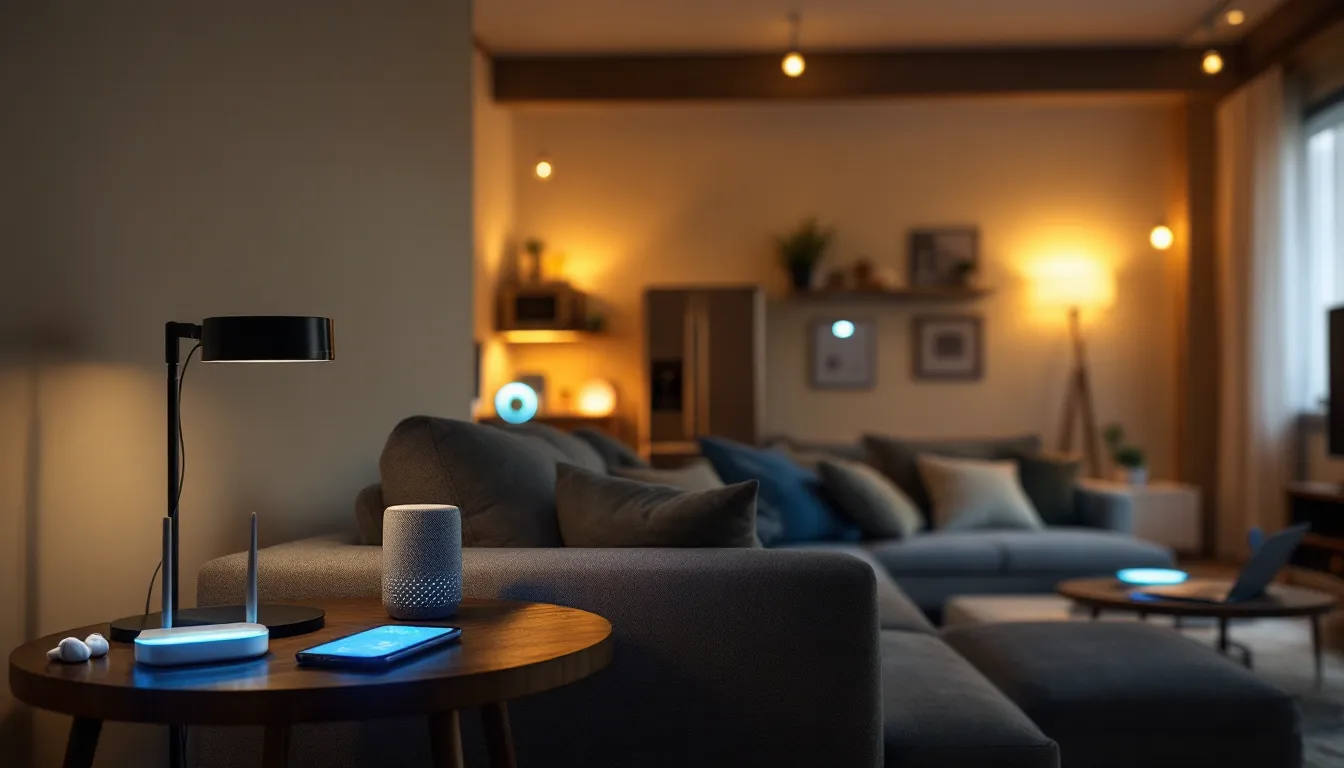
Wireless Devices and Wi-Fi Routers
Your Wi-Fi router is probably the single biggest source of radiofrequency EMF in your home, and it’s broadcasting around the clock. Add to that every phone, tablet, laptop, wireless earbud, baby monitor, and smart home device connected to it, and you’ve got a pretty active electromagnetic environment.
What makes wireless signals particularly relevant from an Ayurvedic perspective is their mobile and subtle nature. These are qualities that increase Vata, they’re invisible, pervasive, and constantly in motion. Your nervous system, which Ayurveda considers a Vata domain, is essentially bathed in this stimulation all day. That matters most during times when your body is trying to shift into rest mode.
I notice it most with my phone. When I carry it in my pocket all day or scroll before bed, there’s a distinct quality of agitation that lingers, like my mind can’t quite land anywhere. That’s Vata doing its thing, amplified by the constant stream of subtle energy.
Appliances, Wiring, and Smart Home Tech
Beyond wireless signals, your home’s electrical wiring and appliances generate their own low-frequency electromagnetic fields. Refrigerators, microwaves, dimmer switches, electric blankets, and even the wiring behind your walls all contribute. Smart home systems, automated lighting, smart thermostats, voice assistants, add another radiofrequency layer on top of that.
These sources tend to carry qualities that are more hot and sharp (think of the warmth generated by electronics) alongside the mobile, subtle qualities of wireless EMF. For Pitta-dominant individuals, being in close proximity to a cluster of running appliances can aggravate that inner heat and sharpness, leading to tension headaches or eye irritation. For Kapha types, the combination of electromagnetic stimulation and sedentary indoor habits can create a kind of stagnation, the body feels heavy but the mind is overstimulated.
Do this today: Identify the three devices closest to where you sleep and where you sit most during the day. Consider whether any can be moved, unplugged, or put on a timer. Five minutes of observation. This is for anyone living in a device-dense home, especially if you’ve been feeling scattered, overheated, or sluggish without an obvious cause.
How to Measure EMF Levels in Your Home
Before you start making changes, it’s worth knowing what you’re actually working with. You don’t need expensive equipment, a basic EMF meter (sometimes called a gaussmeter or RF meter) can give you a general read on the electromagnetic fields in different rooms. In 2026, there are several affordable handheld models available that measure both low-frequency magnetic fields and radiofrequency radiation.
I’d suggest starting with the spots where you spend the most time: your bed, your desk, your couch, and your kitchen. Hold the meter close to where your body actually is, head level at the pillow, hand level at the desk. You might be surprised. The reading next to a powered-down phone on a nightstand can be very different from one that’s actively streaming.
In Ayurvedic terms, this is a form of pratyaksha, direct perception, the most trusted form of knowledge. You’re not guessing. You’re gathering real information about your environment so you can respond wisely. It’s the same principle behind noticing how your body feels after a meal or a particular routine: observe first, then adjust.
If buying a meter isn’t realistic right now, you can still do a qualitative assessment. Pay attention to where you feel most restless, where sleep is most disturbed, and where you tend to feel that subtle agitation or brain fog. Your body is its own sensor, especially when you start tuning into the qualities of your experience rather than pushing through them.
Do this today: If you have or can borrow an EMF meter, do a quick sweep of your bedroom this evening. If not, simply sit quietly in each main room for two minutes and notice what you feel, restlessness, heat, heaviness, calm. Write it down. Takes ten to fifteen minutes. This is for anyone who wants a clearer starting point before making changes.
Practical Ways to Reduce EMF Exposure Without Giving Up Modern Conveniences
Optimize Your Wi-Fi and Device Habits
You don’t need to get rid of Wi-Fi. But you can reduce your exposure significantly with a few simple shifts. Consider putting your router on a timer so it switches off during sleeping hours, roughly 10 PM to 6 AM. This alone removes hours of continuous radiofrequency exposure during the exact window when your body is doing its deepest repair work.
Ayurveda places enormous importance on the nighttime hours as the body’s primary window for building ojas, that deep vitality that supports immunity, emotional stability, and longevity. The qualities your body needs during sleep are heavy, cool, smooth, and stable, basically the opposite of what EMFs bring. Turning off the router at night is one of the simplest ways to let your sleeping environment support what your physiology is already trying to do.
During the day, try switching your phone to airplane mode when you don’t need to be reachable. Use speaker mode or wired headphones for calls instead of holding the phone against your head. And when you’re working at a desk, a wired ethernet connection is faster and produces no RF radiation at all.
Rethink Your Bedroom Setup for Better Sleep
This is where I’d focus first if you’re only going to change one thing. Your bedroom is your body’s sanctuary for rest and restoration. Every device in that room, phone, tablet, smart watch, electric alarm clock, is generating some level of EMF while you sleep.
Try moving your phone to another room at night, or at least across the bedroom and on airplane mode. Swap the electric alarm clock for a battery-powered one. If you use an electric blanket, warm the bed before you get in, then unplug it completely, don’t just turn it off, because the wiring still carries a field when it’s plugged in.
From an Ayurvedic perspective, sleep is governed by Kapha’s qualities, heaviness, stability, coolness, smoothness. These are the qualities that allow your mind to settle and your tissues to rebuild. EMFs in the bedroom introduce the opposite: subtle, mobile, dry, sharp stimulation. It’s like trying to fall asleep in a windstorm. You might manage it, but the rest won’t be deep.
Agni, your metabolic intelligence, also recalibrates during sleep. When sleep quality drops due to environmental disturbance, your agni becomes irregular, which in Ayurvedic terms means incomplete processing happens, and a residue called ama starts to accumulate. You might notice it as a coated tongue in the morning, grogginess, or that heavy feeling that doesn’t lift until mid-morning. Improving your bedroom’s EMF profile can help your digestive fire reset properly overnight.
Make Smarter Choices With Appliances and Electronics
Distance is your friend here. EMF intensity drops off sharply with distance, even moving a few feet away from an appliance makes a meaningful difference. Don’t stand right next to the microwave while it’s running. Keep your laptop on a table rather than directly on your lap. Position your couch so it’s not pressed against a wall that has heavy electrical wiring on the other side.
When you’re shopping for new devices, consider whether the smart version is truly worth it. A regular light switch works perfectly well and doesn’t emit RF signals. A manual coffee maker doesn’t need Wi-Fi. Sometimes the simplest option is also the one most aligned with what Ayurveda calls sthira, stability, steadiness, groundedness.
For prana, your life force and nervous system vitality, reducing the total number of active EMF sources in your daily environment can have a noticeable effect. Prana thrives on clean, clear, open space. Think of the difference between breathing in a cluttered room versus an open meadow. The electromagnetic equivalent of that cluttered room is a house with thirty connected devices all active at once.
Do this today: Choose one of these three areas, Wi-Fi habits, bedroom setup, or appliance distance, and make one concrete change tonight. Takes five to ten minutes to set up. This is for anyone looking to reduce EMF exposure at home in a way that fits real life.
Creating Low-EMF Zones for Children and Sensitive Individuals
Children, elderly family members, and anyone with heightened sensitivity tend to feel the effects of EMF more acutely. In Ayurvedic thinking, this makes complete sense. Children have naturally high Vata, they’re growing rapidly, their nervous systems are still developing, and their tissues are more subtle and permeable than an adult’s. They absorb environmental influences more readily, including electromagnetic ones.
If you have young children, consider making their bedroom and play areas as low-EMF as possible. Keep routers and smart devices out of those rooms. Use wired baby monitors instead of wireless ones if you can find them. And try to keep tablets and phones on airplane mode when kids are using them for games or videos.
For sensitive individuals, and in my experience, this often correlates with a strong Vata constitution or a period of Vata imbalance, creating even one dedicated low-EMF zone in the home can be remarkably supportive. This could be a reading nook, a meditation corner, or simply the bedroom with devices removed. The key quality you’re cultivating is stability, heavy, grounded, still energy to counterbalance the mobile, subtle quality of electromagnetic fields.
This also ties back to ojas. People who are recovering from illness, dealing with chronic stress, or going through major life transitions tend to have depleted ojas. Their resilience is lower, which means environmental stressors, including EMFs, have a proportionally bigger impact. A low-EMF zone gives the body a genuine break and supports the slow, steady rebuilding of that deep vitality.
Do this today: Designate one room or corner of your home as a device-free zone. Remove or power down all wireless devices in that space. Try spending twenty minutes there this evening. This is for families with children, anyone who feels easily overstimulated, or anyone recovering from illness or burnout. It may not be practical for people who live in very small spaces with shared devices, adapt as you can.
Separating EMF Myths From Evidence-Based Guidance
I want to be straightforward here. The scientific research on EMF and health is genuinely mixed. Large-scale studies haven’t conclusively proven that household-level EMF causes specific diseases, but there’s enough preliminary research, particularly around sleep disruption, oxidative stress, and nervous system effects, that being prudent makes sense. The World Health Organization classifies radiofrequency fields as “possibly carcinogenic,” which is a category that reflects uncertainty, not confirmed danger.
What I don’t find helpful is the fear-based content that circulates online, the idea that your Wi-Fi router is slowly killing you, or that you need to spend thousands on shielding paint and special fabrics. That kind of messaging creates more anxiety than the EMFs themselves, and anxiety is its own form of Vata aggravation.
Ayurveda offers a more grounded perspective. Rather than asking “is this definitively harmful or not?” Ayurveda asks, “what qualities does this introduce into my environment, and how are those qualities affecting my balance?” That’s a much more useful question. If turning off your router at night helps you sleep deeper, the mechanism matters less than the result. If reducing screen time in the evening calms your mind, your body is telling you something worth listening to.
The sharp, mobile, subtle qualities of EMFs are real in terms of how they’re experienced, regardless of where the research eventually lands. Ayurveda trusts direct experience, your own perception of what disturbs or supports your balance, as valid knowledge.
Do this today: If you’ve been anxious about EMF, take a breath. Let go of the fear framing and instead approach this as a quality-of-life experiment. Try one change for a week and observe what you notice. Takes no extra time, just awareness. This is for anyone who’s been overwhelmed by conflicting information. It’s not for people seeking a definitive scientific verdict, that’s still evolving.
A Room-by-Room Checklist for Lowering EMF at Home
Let me walk through the home in a practical way, room by room. This is where the twelve tips come together into something you can actually act on.
Bedroom. Put the router on a nighttime timer. Move phones out of the room or switch to airplane mode. Replace electric alarm clocks with battery ones. Unplug electric blankets. If you can, avoid placing the bed against a wall shared with a smart meter or breaker box. The bedroom is your ojas-building sanctuary, protect its cool, heavy, stable qualities.
Living room. Keep a reasonable distance from the TV and any smart speakers. Use wired connections for streaming devices when possible. Consider turning off Bluetooth on devices when you’re not actively using it. This is where many families spend their evenings, so reducing the RF density here supports better wind-down.
Kitchen. Step away from the microwave while it’s running. Keep your phone off the counter where you prepare food, partly for EMF, partly because meals prepared with attention tend to be digested better. Ayurveda has always connected the quality of attention during cooking to the quality of nourishment received.
Home office. Use an ethernet cable instead of Wi-Fi for your main computer. Keep the router in another room if possible. Take breaks every sixty to ninety minutes to step away from your screen and devices, this aligns beautifully with Ayurvedic dinacharya principles, which emphasize rhythm and regular transitions throughout the day.
Children’s rooms. No routers, no smart speakers, no wireless baby monitors if avoidable. Tablets on airplane mode during use. Keep the space as simple, grounded, and stable as possible.
And here’s where seasonal adjustment comes in. During late autumn and winter, the Vata season, when the air is already cold, dry, and mobile, your sensitivity to additional Vata-aggravating influences like EMFs tends to increase. This is a great time to be more diligent about powering down devices at night, spending time in low-EMF zones, and emphasizing warm, oily, grounding foods and routines to counterbalance both the season and the electromagnetic environment.
In contrast, during the heavy, cool, damp Kapha season of late winter and spring, you might notice EMFs bother you less. But this is also the season where ama tends to accumulate, so supporting your agni with lighter foods and keeping your environment uncluttered (both physically and electromagnetically) remains worthwhile.
Do this today: Pick the one room where you spend the most time and carry out two changes from the suggestions above. Fifteen minutes of setup. This is for anyone with a home, renters and homeowners alike. If you’re in a shared living situation, focus on the spaces you personally control.
If You’re More Vata
You’re likely the most sensitive to EMF in your household. The mobile, subtle, dry qualities of electromagnetic fields mirror your own dominant qualities, so you feel the accumulation faster, restless sleep, scattered attention, anxiety that seems to come from nowhere.
Your priority is creating warm, heavy, oily, stable counterbalances. Keep your bedroom especially low-EMF. Do an oil self-massage (abhyanga) in the evening to ground your nervous system before sleep. Eat warm, well-cooked, mildly spiced meals, nothing raw or cold in the evening. And try to have your last screen interaction at least sixty minutes before bed.
One thing to be mindful of: don’t let EMF concern itself become another source of Vata anxiety. Approach changes slowly and gently.
Do this today: Tonight, try putting your phone in another room by 9 PM and doing a five-minute warm oil foot massage before bed. This is for Vata-dominant individuals or anyone currently in a Vata-aggravated state. Not recommended if you have skin conditions that react to oils, use a warm towel instead.
If You’re More Pitta
You might notice EMF effects more as irritability, eye strain, or a heated, overstimulated feeling, especially after long work sessions near multiple devices. The sharp and hot qualities of concentrated electronics resonate with your own Pitta tendencies.
Your priority is cooling and softening your environment. Take regular breaks from screens, step outside, look at something green, splash cool water on your face. Use blue-light filtering on all screens, especially in the afternoon and evening. Keep your workspace ventilated and, if possible, near a window with natural light rather than surrounded by fluorescent fixtures.
One thing to be mindful of: Pitta types can become militant about “optimizing” their environment. Try not to turn this into a competitive project. Ease is the goal.
Do this today: Set a recurring break timer for every ninety minutes during your workday. During each break, step away from all devices for five minutes. This is for Pitta-dominant individuals, especially those who work long hours at screens. It’s less pressing for people who already have a relaxed work rhythm.
If You’re More Kapha
You’re naturally more buffered against EMFs thanks to your heavy, stable, cool, smooth qualities, they provide a kind of constitutional insulation. But that doesn’t mean you’re immune. Kapha types in a state of imbalance may find that the constant subtle stimulation of EMFs creates a paradoxical effect: the mind is wired but the body feels sluggish and unmotivated.
Your priority is keeping things moving and clear. Don’t use the “I’m less sensitive” card as a reason to fall asleep with the TV on every night or keep six devices running in your bedroom. Pay extra attention to your agni, when Kapha’s digestive fire is low and ama is accumulating, any additional environmental stressor can tip the balance toward that foggy, congested feeling.
One thing to be mindful of: Kapha types sometimes resist change out of comfort. Even small environmental shifts, like unplugging the bedroom TV, can support more clarity and lighter energy.
Do this today: Unplug or power down one device in your bedroom that you don’t truly need at night. Then do five minutes of brisk walking or gentle stretching before bed to keep your energy circulating. This is for Kapha-dominant individuals, particularly if you’ve been feeling foggy or lethargic. Less relevant for Kapha types who are already active and sleeping well.
Conclusion
Reducing EMF exposure at home isn’t about perfection or paranoia. It’s about recognizing that your living environment carries qualities, and those qualities either support your rest, your digestion, your clarity, and your vitality, or they quietly work against them.
The Ayurvedic approach I’ve shared here doesn’t ask you to reject technology. It invites you to be more intentional about how and when you engage with it. Turn off what you don’t need. Create pockets of stillness. Let your bedroom be a true place of repair. Pay attention to what your body tells you.
Small, consistent changes, a router timer here, a device-free zone there, an evening oil massage, a seasonal adjustment, these add up. They support your agni, protect your ojas, and help your prana flow with more ease. And the beauty of this approach is that it’s personalized. What works for your Vata-dominant friend might be different from what works for you, and that’s exactly right.
I’d love to hear what resonates with you. Have you tried reducing EMF in your home? What did you notice? Drop a comment below or share this with someone who’s been curious about creating a calmer, more grounding home environment.
What’s one small shift you could make tonight to let your home support you a little more deeply?