






Why the Local vs Organic Debate Still Confuses Consumers
Part of the confusion comes from the fact that “local” and “organic” are answering two very different questions. Organic certification speaks to how food is grown, what goes into the soil, what stays off the plant. Local, on the other hand, speaks to where food comes from and how far it travels to reach your plate.
These aren’t opposing ideas. They’re just measuring different things.
But marketing has muddied the waters. Walk into any grocery store and you’ll see “locally sourced” splashed across packaging right next to “USDA Organic” seals. Both carry a kind of moral weight, a quiet promise that this is the responsible choice. The trouble is, neither label tells the whole environmental story on its own.
There’s also a timing element people overlook. A local strawberry picked in June and a local strawberry grown in a heated greenhouse in January are wildly different products from an environmental standpoint. The calendar matters as much as the map.
And then there’s the sheer volume of conflicting information. One study says food miles are negligible: another says they’re significant. One article champions organic soil health: the next points out that organic yields can require more land. It’s enough to make anyone toss both apples in the cart and call it a day.
But I think the confusion is actually a sign that we’re asking the right questions. It means we care. So let’s untangle this, one thread at a time.
What “Local” Really Means for Your Food
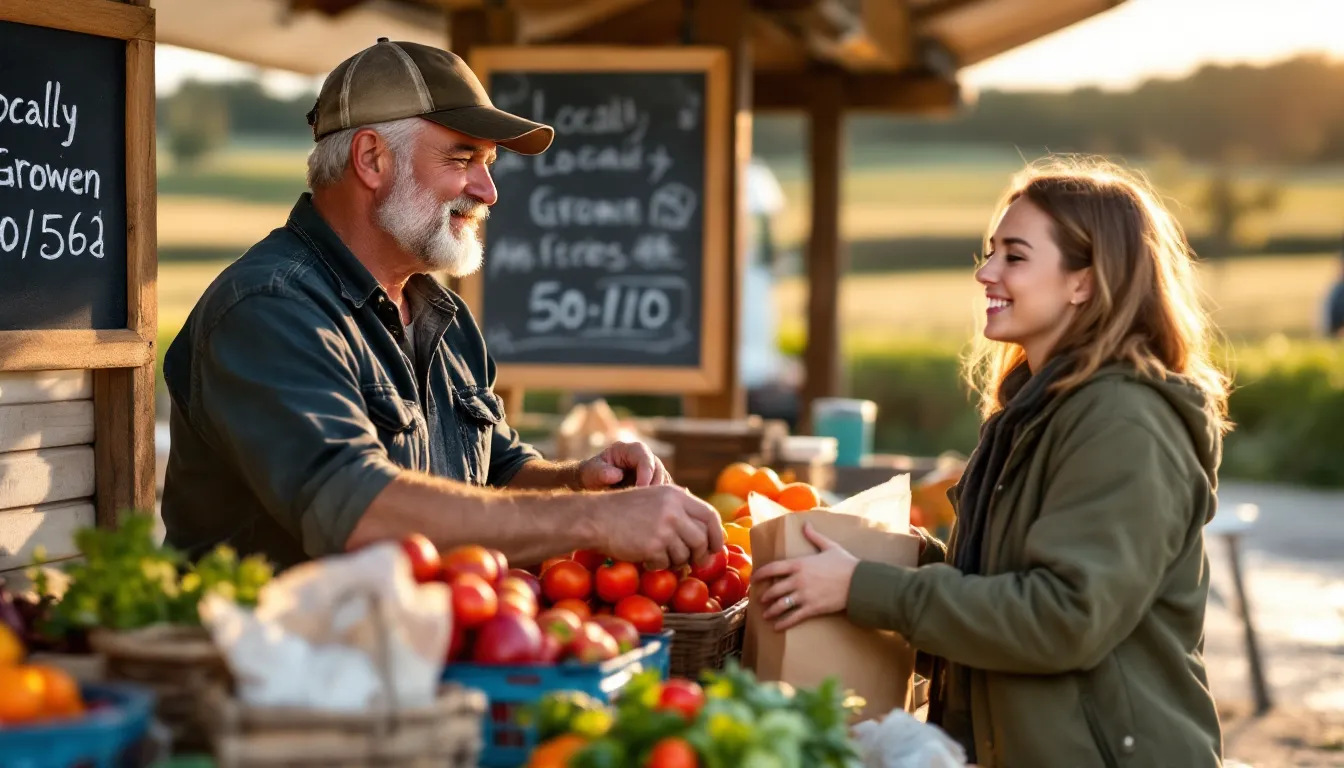
There’s no universal legal definition of “local” food in the United States, which is part of the problem. The USDA has used a 400-mile radius or within-state boundary as a loose guideline, but farmers’ markets, co-ops, and grocery chains each draw the line differently. Some consider anything from the same state local. Others mean the farm is twenty minutes down the road.
What local does generally mean is shorter supply chains, fewer middlemen, and food that was picked more recently.
The Environmental Benefits of Buying Local
The most intuitive benefit is reduced transportation. When your tomatoes travel 30 miles instead of 1,500, the fuel burned and emissions generated drop considerably. A 2024 analysis from the University of Michigan estimated that shifting just 10% of Americans’ produce purchases to local sources could eliminate roughly 4.5 million metric tons of CO₂ equivalent per year, about the same as taking a million cars off the road.
But the benefits go beyond trucks and highways. Local food systems tend to encourage smaller-scale farming, which often (though not always) means more diverse crops, less monoculture, and farming practices more attuned to regional soil and climate conditions. There’s a kind of natural intelligence in growing what the local landscape supports, less fighting against the environment, more working with it.
Local buying also builds community resilience. When you know where your food comes from, there’s accountability. Farmers who sell directly to their neighbors tend to care more about soil health, water use, and land stewardship because they’re living with the consequences.
The Hidden Limitations of Local Food
Here’s where it gets complicated. “Local” says nothing about farming practices. A farm five miles from your house could be dousing crops in synthetic pesticides, over-tilling soil, and draining local waterways. Geography alone doesn’t guarantee environmental responsibility.
There’s also the efficiency question. Large-scale organic operations, even distant ones, sometimes produce lower per-unit emissions because of economies of scale. A massive organic lettuce farm in California with optimized irrigation may actually have a smaller carbon footprint per head of lettuce than a small local farm using outdated equipment and flood irrigation.
And seasonality matters enormously. When local food is grown out of season in energy-intensive greenhouses or cold storage facilities, the environmental math can flip entirely. A heated winter greenhouse in Minnesota might generate more emissions than a sun-grown field in Mexico, transport included.
The takeaway? Local is a powerful piece of the puzzle, but it’s not the whole picture.
What “Organic” Really Means for the Planet
Organic certification, at least in the US, has teeth. The USDA Organic label means no synthetic pesticides, no synthetic fertilizers, no GMOs, no sewage sludge, and no irradiation. For animal products, it means access to the outdoors, organic feed, and no antibiotics or growth hormones.
From an environmental standpoint, these restrictions matter a lot, but they’re not the full story either.
How Organic Farming Reduces Environmental Harm
The biggest environmental win for organic farming is what it doesn’t put into the ecosystem. Synthetic pesticides and fertilizers are major contributors to water pollution, soil degradation, and biodiversity loss. The runoff from conventional farms has created massive dead zones in places like the Gulf of Mexico, where nitrogen-heavy fertilizers fuel algal blooms that choke out marine life.
Organic farming also tends to build healthier soil over time. Practices like cover cropping, composting, and crop rotation, which are common in organic systems, increase soil organic matter, improve water retention, and sequester carbon. A long-running study from the Rodale Institute found that organic soil can sequester up to 1,000 pounds of carbon per acre per year more than conventional soil.
There’s also the biodiversity angle. Organic farms support significantly more pollinators, birds, and beneficial insects. A 2023 meta-analysis published in Nature Ecology & Evolution found that organic fields hosted an average of 30% greater species richness than conventional counterparts.
Where Organic Falls Short on Sustainability
Organic farming generally produces lower yields per acre, anywhere from 5% to 34% less, depending on the crop and region. That means more land is needed to grow the same amount of food, which can contribute to deforestation and habitat loss, particularly in developing countries where organic demand from wealthy nations drives agricultural expansion.
There’s also the transportation factor. Much of the organic produce in US grocery stores travels significant distances. Organic avocados from Peru, organic blueberries from Chile, organic olive oil from Italy, the carbon cost of shipping adds up quickly.
And let’s be honest: organic certification is expensive. Many small, ecologically responsible farms can’t afford it. Some of the best-managed farms I’ve visited don’t carry an organic label because the paperwork and fees are prohibitive. The absence of a seal doesn’t mean the absence of good practice.
Organic is a strong framework, but it wasn’t designed to be a comprehensive environmental metric. It addresses inputs and practices on the farm, not the entire lifecycle of food from field to fork.
The Carbon Footprint Factor: Transportation vs Production
This is where the local vs organic debate gets really interesting, and where a lot of assumptions fall apart.
Most people assume that food miles are the dominant factor in a food’s carbon footprint. It makes intuitive sense: the farther something travels, the more fuel gets burned, the more emissions are released. But research consistently shows that transportation typically accounts for only about 5% to 11% of a food’s total greenhouse gas emissions.
The vast majority of emissions, often 80% or more, come from the production phase. How the food was grown, what inputs were used, how the land was managed, how animals were raised. A 2018 study published in Science by Joseph Poore and Thomas Nemecek, one of the most comprehensive ever conducted on food’s environmental impact, confirmed this: what you eat matters far more than where it comes from, at least in terms of carbon.
That said, there are nuances. Air-freighted foods, things like fresh fish, certain berries, and out-of-season asparagus, can have enormous transport footprints because air freight emits 50 times more CO₂ per ton-mile than ocean shipping. But air-freighted produce represents a small fraction of what’s available in most grocery stores.
For the average consumer, here’s what this means practically: choosing organic over conventional likely reduces more environmental harm (through better soil practices, less chemical pollution, greater biodiversity) than choosing local over distant, unless the local option also happens to be grown using sustainable methods. And the biggest single move you can make for the climate is shifting what categories of food you buy, more plants, fewer animal products, rather than obsessing over origin labels.
But I don’t think this means local doesn’t matter. The carbon calculation misses things that are harder to quantify: community economic health, food system resilience, the cultural value of knowing your farmer, reduced food waste from shorter supply chains. These benefits are real, even if they don’t show up in an emissions spreadsheet.
When Local Beats Organic (and Vice Versa)
So when does local win? And when does organic take the lead?
Local wins when the food is in season, the farm uses responsible growing practices (even without certification), and the alternative is an organic product shipped by air or stored in energy-intensive cold chains. A fresh, in-season peach from a farm 40 miles away that practices integrated pest management is almost certainly a better environmental choice than an organic peach flown in from South America in January.
Local also wins when it means supporting smaller-scale, diversified farms that maintain healthy regional food systems. These farms often rotate crops, manage water thoughtfully, and maintain hedgerows and habitat corridors, practices that benefit the local ecosystem in ways that don’t get captured by any single certification.
Organic wins when you’re comparing production methods head-to-head and the local option uses heavy synthetic inputs. If a nearby farm relies on neonicotinoid pesticides and synthetic nitrogen fertilizer, the organic farm three states away is doing less long-term ecological damage, even with the added transport miles.
Organic also wins for specific high-impact crops. The “Dirty Dozen”, strawberries, spinach, kale, grapes, and others that tend to carry heavy pesticide residues in conventional farming, are crops where choosing organic makes an outsized difference for both environmental and health reasons.
The sweet spot, obviously, is local and organic. Or local and responsibly grown, even without the certification. When both criteria align, you’re getting the lowest transport footprint and the cleanest production methods.
But in the real world, that’s not always available or affordable. And that’s okay. The goal isn’t perfection.
How to Make Smarter Choices at the Grocery Store
I’ve found a few simple mental shortcuts that help me navigate the produce section without spiraling into decision paralysis.
Eat with the seasons first. This one move does more than almost anything else. When you buy fruits and vegetables that are naturally in season in your region, you’re almost automatically reducing transport emissions, avoiding energy-intensive storage, and getting food that was grown in conditions it actually thrives in. In spring and summer, that means berries, stone fruits, leafy greens, tomatoes, and peppers. In fall and winter, think root vegetables, squash, apples, citrus, and hearty greens like kale.
Visit your farmers’ market when you can. Not every week, not for everything, but even one or two trips a month connects you to what’s actually growing near you. Ask farmers about their practices. Many use organic methods without certification. You’ll learn things no label can tell you.
Prioritize organic for high-pesticide crops. If budget is a concern (and for most of us it is), focus your organic spending where it counts most. The Environmental Working Group’s annual Shopper’s Guide to Pesticides in Produce is a practical resource for this. Conventional is perfectly fine for thick-skinned items like avocados, pineapples, and onions.
Reduce animal products where you’re comfortable. I know this isn’t what the headline promised, but the research is clear: the single biggest lever individuals have for reducing their food-related carbon footprint is eating less meat and dairy, particularly beef and lamb. Even small shifts, one or two plant-based meals a week, make a measurable difference.
Don’t let perfect be the enemy of good. Any movement toward more thoughtful food choices is a win. Buying a conventionally grown apple from a local farm is still better than buying no apple because the organic option was too expensive and the local option wasn’t certified.
The Bigger Picture: Seasonal, Regenerative, and Beyond Labels
Here’s something I keep coming back to: the labels we’re debating, local, organic, are blunt instruments trying to describe something much more complex. The health of an entire food system can’t be reduced to a sticker.
That’s why I find myself increasingly drawn to a broader framework: regenerative agriculture. Regenerative farming goes beyond organic’s “do no harm” approach and actively tries to restore ecosystems. It focuses on rebuilding soil health, increasing biodiversity, improving water cycles, and drawing carbon back into the ground. Some regenerative farms are organic: some aren’t. Some are local: some operate at larger scales.
The Regenerative Organic Certification (ROC), launched a few years ago, is starting to gain traction in 2026. It layers soil health, animal welfare, and social fairness on top of existing organic standards. It’s not perfect, no certification is, but it’s pointing in the right direction.
Seasonality is another lens that often gets overlooked in the local vs organic conversation. Eating in rhythm with what the land naturally produces at a given time of year is one of the oldest, most ecologically sound food practices humans have. It predates every label. When we eat strawberries in June and squash in October, we’re participating in a pattern that requires less energy, fewer interventions, and produces less waste.
I also think we need to be more honest about food waste. Roughly 30% to 40% of the US food supply goes uneaten, according to the USDA. That’s a staggering amount of wasted water, land, energy, and emissions. In many cases, reducing what you throw away will do more for the planet than agonizing over whether your lettuce is local or organic.
The bigger picture is really about developing a relationship with your food, where it comes from, who grew it, what season it belongs to, and whether the system that produced it is making the land healthier or depleting it. Labels help. But attention and intention help more.
This article is for educational purposes and reflects general environmental research. It is not medical or nutritional advice. If you have specific dietary needs or health conditions, consult a qualified professional.
Conclusion
If I’ve learned anything from wrestling with the local vs organic question, it’s that the most honest answer is: it depends. It depends on the crop, the season, the farming method, the distance, and what alternatives are available to you.
But “it depends” doesn’t mean “it doesn’t matter.” It means the choice is more personal and contextual than a simple label can capture. And that’s actually empowering, not paralyzing, because it means you get to decide based on what’s real and what’s in front of you.
My own approach has settled into something pretty simple. I eat seasonally as much as I can. I buy from local farmers when it’s practical. I choose organic for the crops where it matters most. And I try not to waste what I buy. That’s not a perfect system, but it’s an honest one.
The planet doesn’t need a few million people making flawless grocery store decisions. It needs a lot of people making slightly better ones, consistently, and paying attention.
What’s your biggest challenge when it comes to choosing between local and organic? I’d genuinely love to hear, drop a comment or share this with someone who’s been standing in that same produce aisle, holding two apples, wondering which one to pick.