





Why Most Cleaning Closets Are Overcrowded and Unnecessary
Here’s something the cleaning industry doesn’t want you to think too hard about: most of the products under your sink are doing the same thing with slightly different packaging. That all-purpose cleaner and your kitchen spray? Nearly identical formulas with different labels. The bathroom tile cleaner and the shower spray? Same story.
Marketing has convinced us we need a specialized product for every surface, every room, every type of mess. But the reality is much simpler. A few well-chosen ingredients, vinegar, baking soda, castile soap, and a couple of essential oils, can handle about 90% of household cleaning tasks. The rest is branding.
I used to fall for it too. I’d see a new “eco” product at the store, toss it in my cart, and feel good about it without reading the label. My closet grew while my confidence in any single product shrank. It took stepping back and actually understanding what cleans, and why, to realize how little I truly needed.
The Environmental Cost of Conventional Cleaning Products
This part is harder to ignore once you see the numbers. According to the Environmental Working Group, the average American household contains around 62 toxic chemicals in its cleaning products alone. These aren’t just sitting in bottles. They’re going down drains and into waterways. They’re off-gassing into the air you breathe while you sleep.
Volatile organic compounds (VOCs) in conventional cleaners contribute to indoor air pollution, the EPA has noted that indoor air can be two to five times more polluted than outdoor air, and cleaning products are a significant contributor. Phosphates in detergents fuel algae blooms in lakes and rivers. Plastic bottles pile up in landfills, even the ones that claim to be recyclable, since only about 5% of plastic in the US actually gets recycled.
And then there’s the carbon footprint of manufacturing and shipping all those specialized products across the country. When you switch to a few concentrated, multi-use ingredients, many of which you can buy in bulk, you’re cutting out an enormous amount of waste, packaging, and pollution at once.
It’s not about being perfect. It’s about recognizing that a simpler approach does less harm and, honestly, works just as well.
The Essential Eco-Friendly Cleaning Supplies You Actually Need
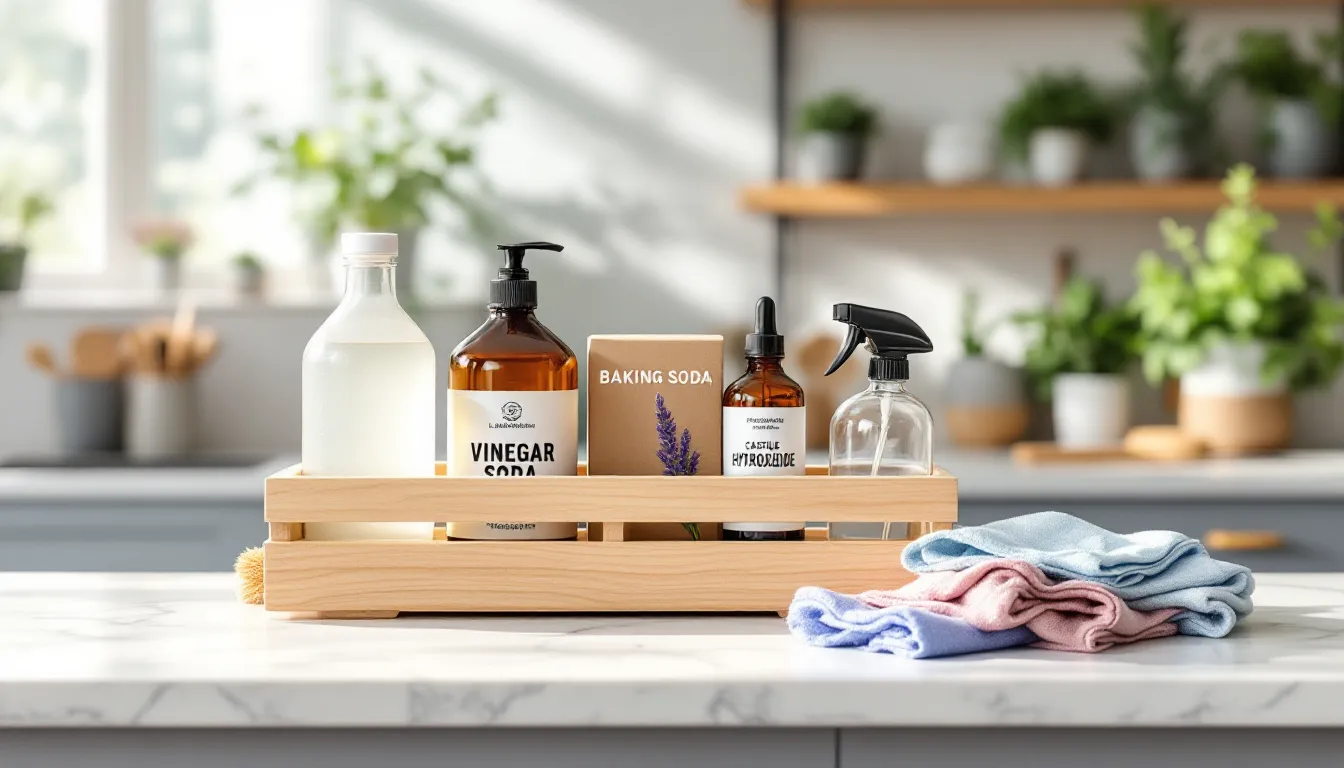
When I finally committed to a minimal cleaning setup, I was surprised by how short the list turned out to be. The key is choosing ingredients that are genuinely versatile, things that pull double and triple duty across surfaces, rooms, and types of grime.
Versatile Natural Ingredients That Do It All
White distilled vinegar is the backbone of my cleaning routine. It cuts grease, dissolves mineral deposits, deodorizes, and acts as a mild disinfectant. I buy it by the gallon. Mixed with water in a spray bottle, it handles countertops, glass, appliances, and bathroom fixtures with zero fuss.
Baking soda is the gentle abrasive I reach for when something needs scrubbing, sinks, tubs, stovetops, even the inside of my oven. It also neutralizes odors like nothing else. A small dish of it in the fridge, a sprinkle in the trash can, a dusting inside shoes, it works quietly and cheaply.
Castile soap, I prefer the unscented liquid variety, is a plant-based soap that’s effective for mopping floors, washing dishes by hand, wiping down walls, and even as a laundry pre-treater. A little goes a very long way. One bottle lasts me months.
Hydrogen peroxide (3%) is my go-to when I need something stronger for disinfecting, cutting boards after raw meat, bathroom surfaces, or anywhere mold likes to creep. It breaks down into water and oxygen, so there’s no toxic residue.
And then there are essential oils, which I use sparingly. Tea tree oil has natural antifungal properties. Lemon oil cuts grease and smells wonderful. Lavender is a nice addition to homemade linen sprays. But these are optional, the cleaning happens with or without them.
That’s five ingredients. Five. They replace easily a dozen commercial products.
The Only Tools Worth Keeping
Ingredients are only half the equation. The tools matter too, and here’s where I really trimmed down.
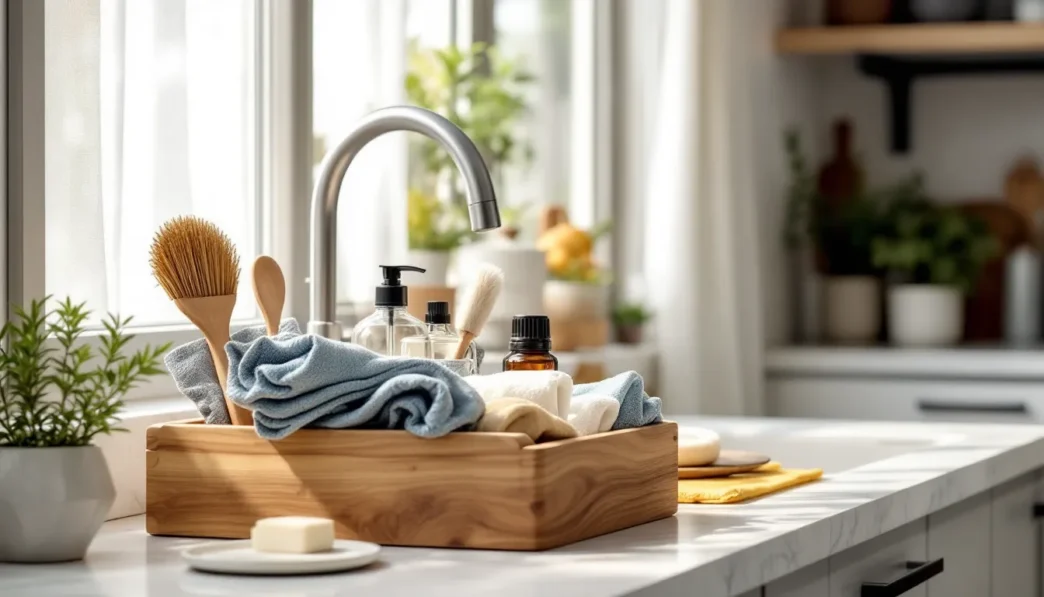
I keep two good spray bottles, one for my vinegar solution, one for an all-purpose castile mix. I have a set of microfiber cloths that I wash and reuse instead of buying paper towels (which, by the way, generate about 13 billion pounds of waste in the US each year). A sturdy scrub brush with natural bristles handles tougher jobs. One good mop with a washable pad replaces disposable mop sheets. And a simple squeegee for glass and shower doors.
That’s it. Everything fits in a single caddy under my kitchen sink. The cleaning closet is now a linen closet, and I’m still a little giddy about the extra space.
Simple DIY Recipes for Every Room in Your Home
I was skeptical about DIY cleaners at first. I think part of me believed that if something didn’t come in a branded bottle with bold claims on the label, it couldn’t really work. But after a few weeks of testing, I became a convert. These recipes are simple, effective, and surprisingly satisfying to make.
Kitchen and Bathroom Solutions
For an everyday kitchen spray, I mix equal parts white vinegar and water in a spray bottle, then add about 10 drops of lemon essential oil. It handles countertops, appliance exteriors, the stovetop, and the inside of the microwave. One important note: don’t use vinegar on natural stone like marble or granite, the acid can etch the surface. For those, I use a damp cloth with a tiny drop of castile soap.
For the bathroom, my go-to scrub is baking soda mixed with just enough castile soap to form a paste. I spread it on the tub, sink, and tile grout, let it sit for five to ten minutes, then scrub with a brush and rinse. It lifts soap scum and hard water stains without scratching. For the toilet, I sprinkle baking soda inside the bowl, add a splash of vinegar (yes, it fizzes, the kids love watching this), let it sit for 15 minutes, then scrub and flush.
For disinfecting kitchen and bathroom surfaces, especially after handling raw food, I spray straight 3% hydrogen peroxide, let it sit for a minute or two, then wipe clean. Simple and effective.
Glass, Floor, and All-Purpose Cleaners
My glass cleaner is one part vinegar to one part water, applied with a spray bottle and wiped with a lint-free microfiber cloth or even old newspaper (which actually works brilliantly and leaves no streaks). I use this on mirrors, windows, and glass tabletops.
For floors, I add about two tablespoons of castile soap to a gallon of warm water. That’s it. It works on tile, sealed hardwood, laminate, and linoleum. For a fresh scent I sometimes add a few drops of tea tree or lavender oil. I avoid vinegar on hardwood floors, over time it can dull the finish.
My all-purpose cleaner is the one I reach for most: one tablespoon of castile soap in a quart spray bottle, filled with water, plus 10 drops of whatever essential oil I’m in the mood for. It wipes down doorknobs, light switches, baseboards, shelving, kids’ toys, and pretty much anything else that needs a quick clean.
How to Transition From a Full Closet to a Minimal Setup
I want to be honest here: the transition wasn’t instant for me, and I don’t think it needs to be for you either. Going from a closet full of products to a caddy of five ingredients is a shift in mindset as much as it is a practical change.
Here’s what worked for me. I started by finishing what I already had rather than throwing everything away at once. Waste is waste, whether it goes down the drain or into a landfill. As each product ran out, I simply didn’t replace it. Instead, I tested whether one of my minimal supplies could do the same job. Almost always, it could.
I gave myself a transition period of about two months. During that time, I kept a few conventional products as backup, just in case. I think I reached for them twice. The confidence builds quickly once you see baking soda tackle a greasy stovetop or vinegar make your shower doors sparkle.
One thing I’d recommend: label your spray bottles clearly. In the early days, I mixed up my vinegar solution and my castile soap spray more than once. A piece of masking tape and a marker solved that problem permanently.
I also found it helpful to make small batches at first. Mix enough all-purpose cleaner for a week or two instead of a month’s worth. This way, you can adjust ratios, try different essential oil combinations, and figure out what you actually like before committing to large quantities.
And don’t forget to check your local hazardous waste disposal options for products you decide to get rid of. Many conventional cleaners shouldn’t just be tossed in the trash, your municipality likely has drop-off days or collection sites for household chemicals.
Saving Money and Reducing Waste With a Minimalist Cleaning Routine
I started tracking my cleaning expenses about six months into the switch, and the numbers genuinely surprised me. Before going minimal, I was spending somewhere around $40 to $50 a month on cleaning products, sprays, wipes, disposable mop pads, specialty cleaners, paper towels. That’s roughly $500 to $600 a year.
Now? A gallon of white vinegar costs me about $3. A box of baking soda is under $1. A bottle of castile soap runs around $12 to $15 and lasts three to four months because you dilute it so heavily. Hydrogen peroxide is a couple of dollars. Essential oils are the most expensive item, and a single bottle lasts ages since you’re only using drops at a time.
My monthly cleaning budget is now closer to $8 to $12. Over a year, that’s a savings of around $400. Not life-changing money, maybe, but not nothing either, especially when you multiply it over a decade.
The waste reduction is where I feel the biggest impact, though. I used to go through a roll of paper towels every week, sometimes more. Now I use washable microfiber cloths that I’ve had for over two years and they’re still in great shape. I’m buying maybe four or five plastic bottles a year instead of dozens. My recycling bin is lighter. My trash is lighter.
There’s also something I didn’t expect: less decision fatigue. When I open the cabinet and there are only a few options, I don’t stand there deliberating. I grab what I need, clean, and move on. It’s a small thing, but it adds up when you’re trying to keep a household running smoothly.
Common Mistakes to Avoid When Switching to Eco-Friendly Cleaning
I made most of these mistakes myself, so consider this a friendly heads-up rather than a lecture.
Mixing vinegar and baking soda in a bottle and expecting magic. I know, I know, the fizzy reaction looks so satisfying. But that fizz is actually the two ingredients neutralizing each other. Once the bubbling stops, you’re left with slightly salty water. They’re both great cleaners, just not combined in a sealed container. Use them sequentially, baking soda to scrub, then vinegar to rinse, or use them separately.
Using vinegar on everything. Vinegar is acidic, and that acid is great for cutting mineral deposits and grease. But it’s not great for natural stone countertops (marble, granite, soapstone), unsealed grout, or hardwood floors. I learned the marble thing the hard way on a friend’s countertop. Check the surface first.
Expecting DIY cleaners to smell like commercial ones. Commercial cleaners are engineered with synthetic fragrances designed to linger and signal “clean” to your brain. Natural cleaners smell… natural. The vinegar smell dissipates within minutes of drying. If the scent still bothers you, essential oils help, but the goal is a clean home, not a perfumed one.
Going all-in overnight and feeling overwhelmed. Transitions work better when they’re gradual. Swap out one product at a time. Test things. Build confidence. There’s no deadline here.
Believing “natural” on a label means safe or minimal. Greenwashing is rampant in the cleaning industry. Products labeled “natural” or “green” can still contain synthetic fragrances, preservatives, and irritants. If you’re buying a commercial eco-friendly product, read the full ingredient list. Better yet, make your own, then you know exactly what’s in it.
This is general education, not medical advice. If you’re pregnant, managing a condition, or taking medication, check with a qualified professional, especially about essential oil use around children, pets, or sensitive individuals.
Conclusion
Looking back, the biggest surprise of going minimal with my cleaning routine wasn’t the money saved or the reduced waste, though both of those are real and meaningful. It was how much lighter the whole process felt. Cleaning stopped being this chore that required a closet full of specialized products and a mental inventory of which bottle goes where. It became straightforward. Almost meditative, on a good day.
You don’t need to overhaul everything at once. Start with one spray bottle of diluted vinegar and a box of baking soda. Use them for a week. See what happens. I think you’ll be surprised by how capable those two simple ingredients are, and how quickly the rest of your cleaning closet starts to feel redundant.
The planet benefits. Your wallet benefits. Your indoor air quality benefits. And honestly, there’s a quiet satisfaction in knowing that the simplest approach is often the most effective one.
I’d love to hear where you are in this process. Have you already started paring down your cleaning supplies? Are you skeptical about whether vinegar can really replace your favorite spray? Drop a comment below, I read every single one, and I’m always happy to troubleshoot recipes or share what’s worked for me.