





The True Cost of Food Waste You Might Not Realize
When we toss food, we tend to think of it as a small thing, a bruised apple here, some leftover rice there. But the cumulative picture is staggering, both for the environment and for our wallets.
Environmental Impact Beyond the Landfill
Here’s something that genuinely surprised me when I first learned it: food waste is one of the largest contributors to greenhouse gas emissions worldwide. When food decomposes in landfills, it produces methane, a gas that traps heat in the atmosphere far more aggressively than carbon dioxide over a 20-year period.
But the environmental cost starts long before the landfill. Think about all the water used to grow those tomatoes you forgot about. The fuel burned to transport that bag of salad greens from farm to store to your kitchen. The fertilizer, the packaging, the refrigeration energy. When food goes uneaten, every single one of those resources goes with it.
According to the UN Environment Programme, roughly a third of all food produced globally is lost or wasted each year. That’s around 1.3 billion tons. It’s a scale that’s hard to wrap your head around, but it starts to feel more real when you look at your own kitchen.
How Much Money the Average Household Throws Away
The financial side hits closer to home. Studies from the USDA and various consumer research organizations estimate that the average American household wastes somewhere between $1,500 and $2,500 worth of food per year. That’s not a rounding error, that’s a vacation, a few months of car payments, or a solid emergency fund contribution.
I started tracking my own waste loosely for a month, and the number shocked me. It wasn’t dramatic, meal-sized waste. It was the slow drip: the herbs I bought for one recipe and never touched again, the yogurt that expired two days before I remembered it, the bread heels nobody wanted. Those small losses add up with quiet persistence.
Why We Waste So Much Food in the First Place
I think most of us don’t waste food because we’re careless. We waste it because modern life is designed in ways that make waste almost inevitable, unless we deliberately push back.
Grocery stores are built around abundance. Bulk deals tempt us into buying more than we can reasonably use. We shop hungry and optimistic, filling our carts with ingredients for meals we may never actually cook. And portion sizes, whether at restaurants or in packaged products, rarely match what a single person or small household can finish.
There’s also the confusion factor. “Best by,” “sell by,” “use by”, these labels sound authoritative, but most of them aren’t safety dates at all. They’re manufacturer suggestions for peak quality. I’ve thrown away perfectly good food because a date on a label made me nervous, and I know I’m not alone in that.
Then there’s the sheer busyness of daily life. You plan to cook that chicken on Wednesday, but Wednesday turns into takeout night because you’re exhausted. By Friday, you’re not sure the chicken is still good, so out it goes. No single instance feels wasteful. It’s the pattern that costs us.
Understanding why we waste is the first step toward changing the habit. And the good news? Most of the fixes are surprisingly simple.
Smart Shopping Habits That Prevent Waste Before It Starts
The most effective place to fight food waste isn’t in the kitchen, it’s in the store. Or really, it’s before you even walk through the door.
Plan Your Meals Around What You Already Have
I used to plan my meals for the week and then go shopping, which sounds responsible but had a flaw: I’d ignore what was already sitting in my fridge and pantry. Now I do it the other way around. I open the fridge, check what needs to be used soon, and build my meal plan from there.
It’s a small mental shift that makes a big difference. That half-head of cabbage becomes the base for a slaw. The can of chickpeas that’s been sitting in the pantry for three months finally gets its moment. I only buy what I genuinely need to fill the gaps.
A quick inventory before shopping also means shorter grocery lists, and shorter trips. I’ve found that I spend about 20% less per week just by shopping with more intention.
Rethink How You Read Expiration Dates
This one changed my relationship with food waste more than almost anything else. Once I learned that “best by” dates are about quality, not safety, I stopped reflexively tossing things that were a day or two past the label.
Your senses are remarkably good at telling you whether food is still fine. Does it smell off? Does it look different? Is the texture wrong? If none of those red flags are present, that yogurt with yesterday’s date is almost certainly fine.
Obviously, use common sense, raw meat and dairy deserve more caution than a jar of salsa. But developing confidence in your own judgment, rather than deferring entirely to printed dates, can save you a surprising amount of food and money each month.
Storage Techniques That Keep Food Fresh Longer
Even with better shopping habits, food will spoil faster than it needs to if you’re storing it wrong. And I say this as someone who used to just throw everything into the crisper drawer and hope for the best.
Proper Fridge and Freezer Organization
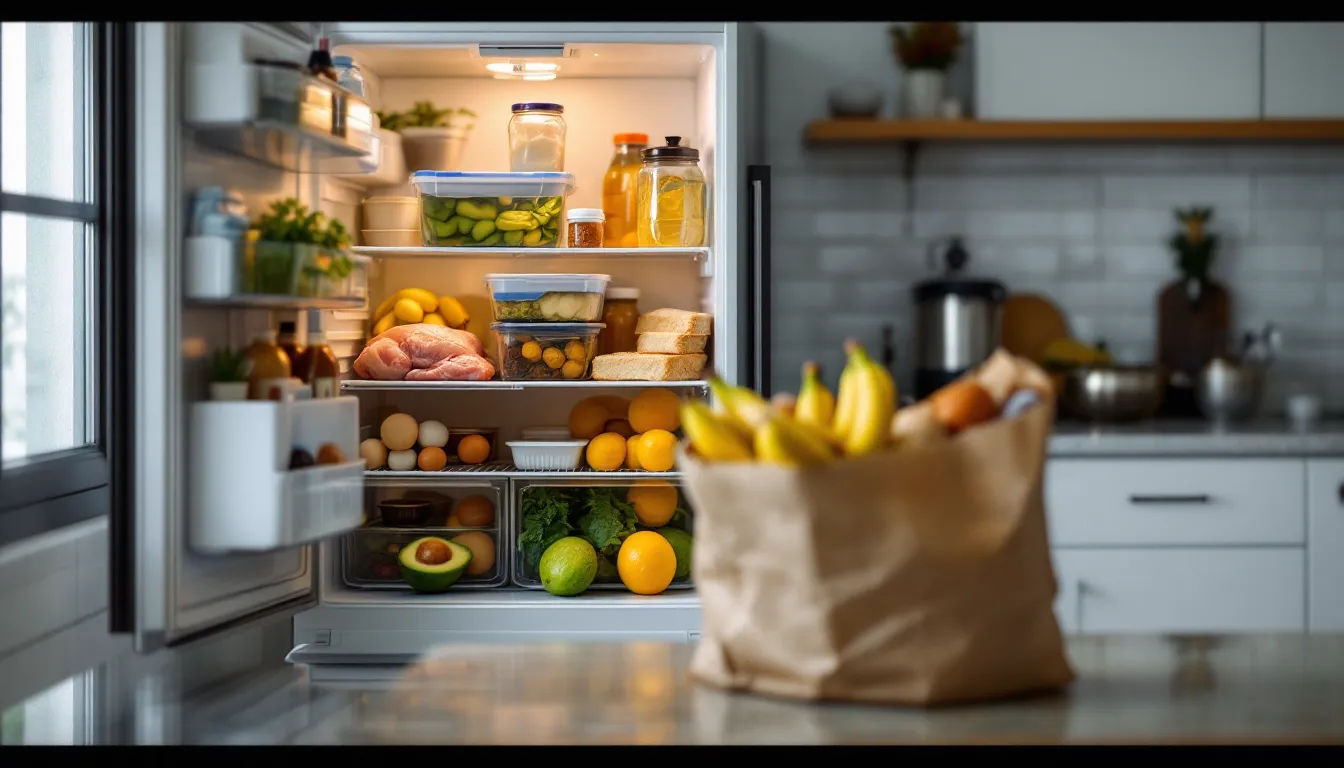
The simplest rule I’ve adopted: first in, first out. When I unpack groceries, newer items go behind older ones. It sounds almost too basic to mention, but it’s transformed how much I actually use before things go bad.
Temperature matters more than most people realize, too. Your fridge should be at or below 40°F (4°C), and your freezer at 0°F (−18°C). I bought a cheap fridge thermometer a couple of years ago, and it turned out mine was running about five degrees warmer than I thought. That small difference was accelerating spoilage on everything from berries to deli meat.
The freezer is also wildly underused by most of us. Bread, cooked grains, soups, ripe bananas, fresh herbs in olive oil, all of these freeze beautifully. I now have a small section of my freezer dedicated to “rescue” items: things I froze just before they would’ve gone to waste.
Simple Tricks for Extending Produce Shelf Life
Produce is the single biggest category of household food waste, and a lot of it comes down to storage mistakes. Here are a few adjustments that made a real difference for me.
Herbs like cilantro and parsley last dramatically longer when you treat them like flowers, trim the stems, put them in a jar of water, and loosely cover with a bag in the fridge. I’ve kept cilantro fresh for over two weeks this way.
Berries benefit from a quick vinegar rinse (one part vinegar to three parts water) before storing. It kills the mold spores that make them fuzzy within days. Pat them dry, store them in a container lined with a paper towel, and they’ll last noticeably longer.
And keep ethylene-producing fruits, apples, bananas, avocados, away from ethylene-sensitive vegetables like lettuce and broccoli. That invisible gas accelerates ripening and decay in nearby produce. A little separation goes a long way.
Creative Ways to Use Leftovers and Scraps
I’ll be honest, I used to view leftovers as a chore. Reheated versions of Tuesday’s dinner never felt exciting. But once I started thinking of leftovers as ingredients rather than finished meals, everything shifted.
Leftover roasted vegetables become the filling for quesadillas or the base of a frittata. Last night’s rice turns into fried rice with whatever vegetables are lingering in the crisper. Stale bread gets torn into cubes, tossed with olive oil and garlic, and baked into croutons that are honestly better than store-bought.
Scraps deserve attention too. Vegetable trimmings, onion skins, carrot tops, celery ends, mushroom stems, can be collected in a freezer bag over the course of a week or two. Once the bag is full, simmer everything in water for about an hour, strain it, and you’ve got a rich vegetable broth that cost you nothing.
Parmesan rinds are another one. Drop them into soups or stews while they cook. They melt slowly and add this incredible depth of savory flavor. I used to throw those away without a second thought, and now they’re one of my favorite kitchen “secrets.”
The mindset shift is the real change here. When you start seeing potential in what you’d normally discard, waste drops naturally, and cooking gets more creative in the process.
Building a Waste-Reduction Routine That Sticks
Habits only work if they’re sustainable. I’ve tried overly ambitious waste-reduction plans before and abandoned them within a couple of weeks. What actually sticks are small routines woven into what you’re already doing.
Track Your Waste to Measure Progress
This doesn’t need to be complicated. For one month, try keeping a simple log, a notepad on the counter, a note on your phone, where you jot down what you throw away and roughly why. “Half avocado, forgot about it.” “Leftover soup, made too much.”
After a few weeks, patterns emerge. Maybe you consistently overbuy produce on weekends. Maybe you always forget about leftovers by day three. Those patterns are gold because they tell you exactly where to focus.
I found that my biggest waste category was fresh herbs and leafy greens. Once I saw that clearly, I started buying smaller quantities and freezing what I couldn’t use right away. My waste dropped noticeably within a month.
Composting What You Can’t Eat
No matter how diligent you are, some food waste is inevitable, eggshells, coffee grounds, banana peels, the truly spoiled stuff. Composting gives that waste a second life instead of sending it to a landfill where it generates methane.
If you have outdoor space, a basic compost bin is inexpensive and low-maintenance. If you’re in an apartment, countertop compost systems and community drop-off programs have become much more accessible in recent years. Many cities now offer curbside composting as well, it’s worth checking what’s available in your area.
Composting felt like an “extra” step when I first started, but now it’s automatic. The kitchen scrap bin sits right next to the trash, and most days more goes into compost than into the garbage.
Teaching Your Household to Waste Less Together
Here’s something I learned the hard way: reducing food waste is a lot harder when you’re the only one in the house who cares about it.
I tried being the sole food-waste guardian for a while, rearranging the fridge, rescuing forgotten leftovers, composting everything myself. It was exhausting and slightly resentful. What actually worked was making it a household conversation rather than a solo mission.
With kids, framing it around money can be surprisingly effective. “That banana you just threw away? That was 30 cents. If we waste one banana a day, that’s almost $110 a year, enough for a new video game and then some.” Suddenly, they’re interested.
For partners or roommates, I’ve found that involving people in the meal-planning process helps. When someone has a say in what’s being cooked, they’re more invested in actually eating it. It also distributes the mental load, which is its own kind of relief.
Small shared rituals help too. A weekly “clean out the fridge” night where you build a meal from whatever needs to be used. A designated shelf in the fridge for “eat this first” items. A shared grocery list app so nobody buys duplicates.
The goal isn’t perfection, it’s awareness. Once everyone in the house starts noticing waste, the reduction happens almost organically.
A quick note: This article is general education and lifestyle guidance, not professional financial or environmental consulting. If you have specific dietary needs, allergies, or health conditions, always check with a qualified professional before making significant changes to your eating habits.
Conclusion
Reducing food waste doesn’t demand a radical lifestyle change. It asks for attention, a little more awareness when you shop, a bit more creativity when you cook, and the willingness to look at what’s already in your fridge before reaching for something new.
The ten habits I’ve shared here aren’t theoretical. They’re the ones that survived my own trial-and-error process and became part of how I actually live. Some weeks I’m better at it than others. That’s fine. Progress matters more than perfection, and even small reductions add up to meaningful savings, for your budget and for the planet.
If you take away one thing from this piece, let it be this: the food you save from the trash is money you keep in your pocket and resources you return to the earth. That’s a pretty good deal.
I’d love to hear what’s working for you. What’s your go-to trick for reducing waste in your kitchen? Drop a comment below or share this with someone who might find it helpful, sometimes the best ideas come from the people around us.