








Why Your Bedroom Environment Matters More Than You Think
In Ayurveda, sleep, or nidra, is one of the three pillars that hold up your entire well-being, right alongside food and balanced living. When sleep goes sideways, everything downstream suffers: digestion slows, immunity dips, and that deep reservoir of vitality called ojas starts to thin out.
The trouble is, most of us focus only on when we sleep, not where. But your bedroom carries qualities, warm or cool, dry or moist, cluttered or spacious, bright or dim, and those qualities directly influence which energies get stirred up at night.
If your room runs hot and sharp (think glaring screens, bright overhead lights, a stuffy space), it fans Pitta energy and keeps your mind in problem-solving mode long after you’ve turned in. If it’s cold, drafty, and chaotic, clothes on the floor, papers everywhere, unsteady noise, that’s Vata territory, and your nervous system stays mobile and restless. A room that’s too heavy and damp, with stagnant air and piles of unused stuff, can aggravate Kapha, leading to that sluggish, unrefreshed feeling even after eight hours.
The Ayurvedic view is beautifully practical here: the space around you is an extension of your body’s environment. Change the qualities of the room, and you change the conditions for rest.
Do this today: Walk into your bedroom tonight with fresh eyes. Notice what feels off, is the air stale, is the light harsh, does the space feel heavy or chaotic? Just notice. Takes about two minutes. This works for everyone, regardless of your constitution.
Set the Ideal Temperature for Restorative Sleep
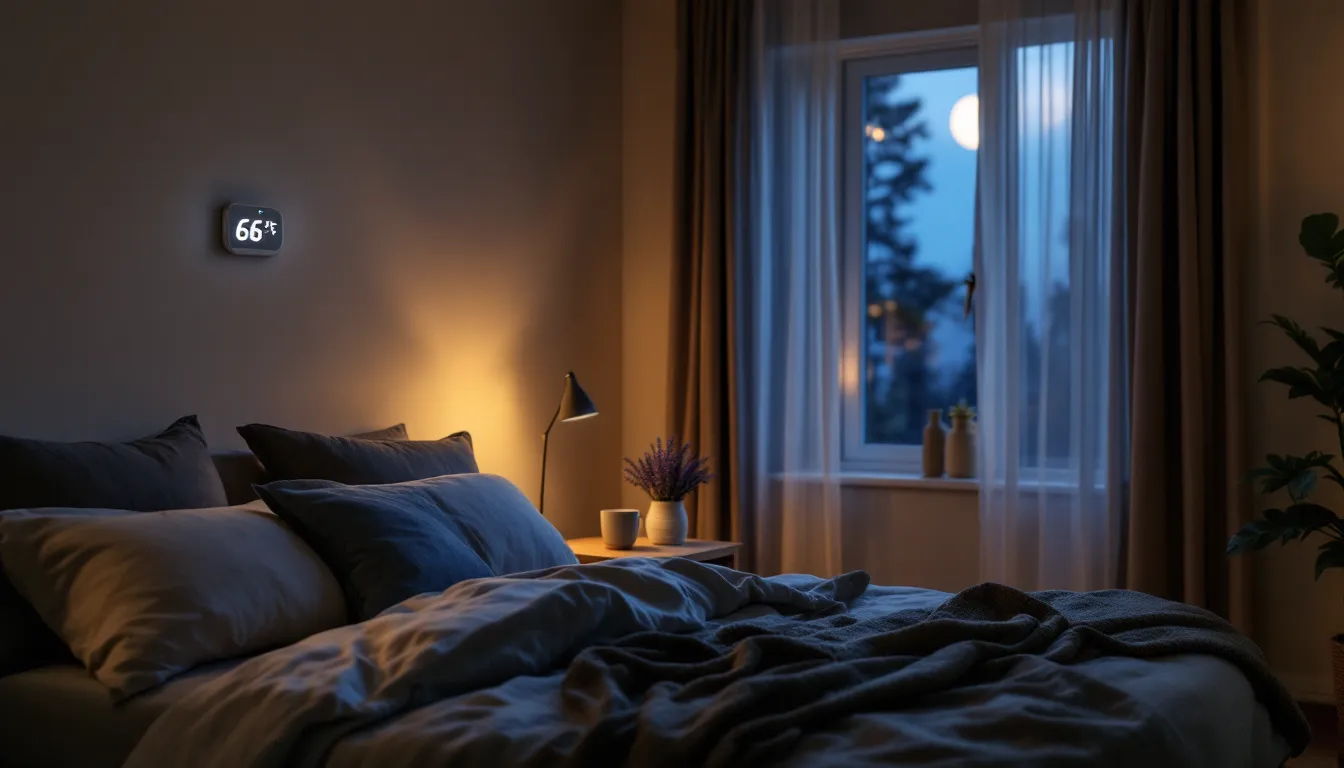
Temperature is one of the most powerful qualities you can control in your bedroom environment. Ayurveda frames this through the hot/cool quality pair, and nighttime is naturally a cooling period. Your body temperature drops as the evening deepens, which is part of how your system signals that it’s time to wind down.
When a room stays too warm, it keeps Pitta active. You might notice sharp, vivid dreams, waking between 10 PM and 2 AM (Pitta’s peak hours), or feeling irritable the next morning. That metabolic spark, what Ayurveda calls tejas, stays turned up when it needs to settle.
When a room is too cold and dry, Vata gets aggravated. Your body contracts, muscles tighten, and your mind drifts into that light, easily-disturbed kind of sleep.
The sweet spot? A cool but not cold room, somewhere around 65–68°F for most people. If you tend to run warm, you might prefer the lower end. If you tend toward cold hands and feet, a slightly warmer room with heavier bedding often works better.
This also ties directly to your digestive fire, or agni. When your body doesn’t have to work overtime to regulate temperature, metabolic energy gets redirected toward nighttime repair. That’s when your tissues rejuvenate and ojas gets replenished.
Do this today: Adjust your thermostat or open a window slightly before bed tonight. Aim for cool, not cold. Takes thirty seconds. This is especially helpful for Pitta types who run warm, but everyone benefits. If you have circulation issues or Raynaud’s, layer up with socks and a blanket instead of heating the whole room.
Control Light Exposure to Protect Your Circadian Rhythm
Light is perhaps the single biggest environmental cue your body uses to determine when to be alert and when to rest. Ayurveda understood this long before circadian biology entered the conversation, daily rhythm, or dinacharya, is built around the movement of the sun.
Natural Light During the Day
Getting bright, natural light in the morning is one of the simplest things I’ve done to improve my sleep at night. It sounds almost too basic, but the logic runs deep. Morning sunlight carries sharp, warm, stimulating qualities, it activates Pitta’s metabolic intelligence and sets your internal clock.
When you miss that morning light (working indoors all day, curtains drawn until noon), your body loses its temporal anchor. The distinction between day energy and night energy gets blurred. Your prana, that vital life force tied to your nervous system, doesn’t get the clear signal to shift gears come evening.
Try stepping outside within the first hour of waking, even for ten minutes. Let the light hit your face.
Blocking Light at Night
Once the sun sets, the opposite qualities matter. Cool, dark, and heavy are what your bedroom environment needs. Even small amounts of artificial light, a charging indicator on your phone, light from a hallway, a digital clock, carry sharp, subtle stimulating qualities that can keep Vata and Pitta from settling.
Blackout curtains or a simple sleep mask can make a surprising difference. I noticed it within the first few nights: fewer middle-of-the-night wake-ups, and a more grounded feeling in the morning.
Do this today: Tonight, turn off or cover every light source in your bedroom. If you need a nightlight for safety, choose one with a warm amber tone rather than blue or white. Takes five minutes to set up. This is great for everyone but particularly helpful for Pitta types who tend toward light, easily-disrupted sleep. Not ideal if you have safety concerns navigating a fully dark room, keep one warm, low light source near the floor.
Reduce Noise or Use Strategic Sound to Your Advantage
Sound carries the mobile and subtle qualities that Vata is most sensitive to. A sudden noise in the night, a car alarm, a neighbor’s TV, even the hum of a refrigerator through the wall, jolts the nervous system because it introduces movement into a space that’s supposed to be stable.
If you live somewhere noisy, the goal isn’t necessarily silence (which can feel eerily empty for some people and actually increase Vata’s tendency toward anxiety). Instead, think about introducing stable, smooth, continuous sound. A fan running at a consistent speed. A white noise machine set to a low, steady tone. These create a kind of sound blanket, heavy and uniform enough to absorb the sharp, irregular noises that startle you awake.
I’ve personally found that nature sounds, gentle rain, a low river, work well because they carry a grounding, earthy quality. Avoid anything with sudden shifts in volume or rhythm, which just mimics the mobile quality you’re trying to calm.
From an Ayurvedic perspective, stable sound supports the downward-moving energy called apana vayu, which governs relaxation, elimination, and the ability to truly let go. When that energy flows well, you don’t just fall asleep, you sink into it.
Do this today: If outside noise disrupts your sleep, try a fan or a free white noise app at a low volume tonight. Give it three nights before judging. Takes about one minute to set up. Especially helpful for Vata-dominant types and light sleepers. If continuous sound bothers you, try earplugs instead, some people do better with true quiet.
Choose a Mattress, Pillows, and Bedding That Fit Your Body
Your bed is where the quality pairs of soft/hard, light/heavy, and smooth/rough show up in a very tactile way. And the wrong combination can quietly disrupt your rest night after night.
Vata types, who tend toward lighter frames, dry skin, and restless sleep, generally do better with a mattress that’s on the softer, more cushioning side. Something that holds and supports rather than pushes back. Heavy, smooth, slightly oily-feeling fabrics (think cotton sateen or silk) help counterbalance dryness.
Pitta types often run warm and may prefer breathable, cool-to-the-touch materials. Cotton percale, linen, or bamboo blends can wick heat away. A medium-firm mattress tends to work well, supportive without trapping too much warmth.
Kapha types, who sometimes sleep too heavily and wake up groggy, can benefit from a slightly firmer mattress and lighter-weight bedding. A room that doesn’t feel too cocooning keeps Kapha’s natural heaviness from tipping into dullness.
The deeper point here is that your bedding is part of your vihara, your lifestyle practices. It’s not vanity or luxury. It’s creating the physical conditions for your tissues to repair and for ojas to rebuild overnight.
Do this today: Assess your pillows, if they’re flat, lumpy, or over two years old, consider replacing them. That alone can shift your sleep quality. Takes a few minutes to evaluate. Good for everyone. If you have allergies or respiratory sensitivities, look for hypoallergenic fills and wash bedding weekly in hot water.
Declutter and Simplify Your Sleep Space
This one surprised me the most. I didn’t think the stack of laundry on my chair was affecting my sleep, but it was.
Clutter carries heavy and dull qualities. It also introduces a subtle mental weight. Your eyes scan it, your brain processes it, and even if you don’t consciously register the mess, your nervous system does. That’s ama in a non-digestive sense, residue that hasn’t been processed or dealt with, creating stagnation.
In Ayurveda, ama isn’t only about food. It’s about anything undigested, emotions, experiences, physical stuff. A cluttered room mirrors a cluttered mind, and both interfere with the body’s ability to cleanse and restore during sleep.
The fix doesn’t require a full Marie Kondo overhaul. Start with surfaces. Clear your nightstand down to the essentials, maybe a glass of water and a book. Move laundry out of the bedroom. If storage is limited, even closing closet doors or using a simple basket to contain visual chaos helps.
When the space feels open and uncluttered, there’s more room for prana, life force, to circulate. You might notice your breathing deepens. That’s not a coincidence.
Do this today: Spend ten minutes clearing visible clutter from your bedroom tonight. Just the surfaces. Takes ten minutes. Helpful for everyone, but especially Kapha types who are prone to accumulation, and Vata types whose minds mirror the chaos around them. If the task feels overwhelming, start with one surface, just the nightstand.
Pick Calming Colors and Minimize Screen Presence
Color affects mood, that’s not news. But Ayurveda frames it through qualities. Bright reds and oranges carry hot, sharp, stimulating qualities that provoke Pitta. Stark whites and grays can feel cold, dry, and mobile, unsettling for Vata. Very dark, heavy tones might deepen Kapha’s tendency toward inertia.
For a bedroom environment that supports all constitutions, I lean toward soft, warm neutrals, think muted earth tones, gentle blues, soft greens. These carry cool, smooth, stable qualities without being either too stimulating or too heavy.
And then there’s the screen issue. A television in the bedroom, a laptop on the nightstand, a phone on the pillow, these are concentrated sources of sharp, bright, mobile energy. They keep the mind in rajas, that agitated, outward-moving state, right when you need to shift into calm, inward-moving stillness.
I moved my phone charger to another room about a year ago. It felt uncomfortable for the first week. Then it felt like freedom.
Do this today: Move your phone charger out of arm’s reach, ideally out of the bedroom entirely. If you use it as an alarm, try a simple battery-powered clock instead. Takes two minutes. Good for everyone. If you rely on your phone for medical alerts or safety, keep it nearby but turn the screen fully face-down and enable do-not-disturb mode.
Improve Air Quality and Ventilation
Stale air is one of the most overlooked aspects of a bedroom environment. In Ayurvedic terms, stagnant air carries heavy, dull, gross qualities, it depresses prana, the life force that governs your breath, your nervous system’s responsiveness, and the subtle feeling of aliveness you wake up with (or don’t).
When prana can’t move freely, your body’s nighttime cleansing processes slow down. You might wake up congested, foggy, or with a coated tongue, all signs that ama has accumulated because your system couldn’t complete its overnight housekeeping.
The simplest fix is cross-ventilation. Crack a window, even slightly, let fresh air replace what’s been sitting all day. If outdoor air quality is poor or the weather doesn’t cooperate, a small HEPA air purifier can help keep the air light and clean.
Indoor plants are another option, though I’d keep them minimal. One or two low-maintenance plants like a snake plant or pothos can gently improve air quality without adding too much moisture (which could aggravate Kapha in humid climates).
Do this today: Open your bedroom window for at least fifteen minutes before bed to let fresh air circulate, then close it if needed for temperature or noise. Takes no extra effort. Helpful for everyone, but especially Kapha types prone to morning congestion. If you have pollen allergies, skip the open window and use a purifier with a HEPA filter instead.
Establish Scent and Sensory Cues That Signal Rest
Smell is our most ancient sense, and Ayurveda uses it deliberately. Certain aromas carry specific qualities that can shift your internal state in seconds.
Lavender, for example, is cool, smooth, and calming, it soothes Pitta’s intensity and helps settle Vata’s restlessness. Sandalwood is cool and heavy, grounding for anyone who feels mentally scattered at night. Vetiver is earthy, dense, and deeply stabilizing, almost like an aromatic anchor.
The key here is consistency. When you use the same scent every night before bed, your body starts to associate that smell with sleep. It becomes a sensory cue, a gentle signal to your nervous system that it’s time to transition. This is a form of building healthy samskaras, or patterns, through your environment.
I keep a small bottle of lavender oil on my nightstand and put a single drop on my pillowcase. That’s it. Nothing elaborate.
Over time, this kind of sensory ritual supports your body’s natural tejas, the subtle metabolic intelligence that governs transitions. When tejas is balanced, you move smoothly from wakefulness to drowsiness to deep rest, rather than lying there with your eyes closed and your mind spinning.
Do this today: Choose one calming scent, lavender, chamomile, or sandalwood, and place a drop on your pillowcase or a cotton ball near your bed tonight. Takes thirty seconds. Good for everyone. Avoid if you’re sensitive to fragrances or have respiratory conditions, in that case, fresh air alone is your best sensory cue.
Putting It All Together: A Room-by-Room Action Plan
Now, I want to bring all of this together into something you can actually use, because nine changes at once isn’t realistic, and Ayurveda wouldn’t recommend that anyway. Sudden, sweeping change carries that mobile, erratic Vata quality. Slow, steady adjustments are more likely to stick.
Here’s how I’d approach it.
This week: Handle temperature and light. Adjust your thermostat, cover or remove light sources, and get morning sunlight within the first hour of waking. These two daily rhythm habits, syncing with the sun and cooling the room at night, form the foundation of a sleep-supportive dinacharya.
Next week: Address sound and air quality. Set up a white noise source if needed, and start airing out the room before bed each evening. Notice how your breathing changes when the air is fresh.
Week three: Tackle the tactile and visual layer. Declutter surfaces, evaluate your bedding, move screens out. Add one calming scent.
If You’re More Vata
Your bedroom environment needs warmth, weight, and stability. Opt for heavier blankets, soft textures, warm amber lighting in the evening, and a consistent bedtime (ideally by 10 PM, before Vata’s late-night hours kick in). A small cup of warm milk with a pinch of nutmeg before bed can ground you beautifully. Avoid cold, drafty rooms and falling asleep with the TV on, the flickering light and shifting sounds are pure Vata aggravation.
Do this today: Add one grounding element to your bedroom, a heavier blanket, a warm drink ritual, or a drop of vetiver oil. Takes five minutes. Best for Vata-dominant types or anyone experiencing restless, light sleep. Not ideal if you tend to feel sluggish and heavy upon waking, that points more toward Kapha imbalance.
If You’re More Pitta
You need cool, soft, and spacious. Keep the room temperature on the lower end, use breathable fabrics, and choose cool-toned colors. Avoid working in bed or bringing your laptop into the bedroom, Pitta’s driven nature will turn the bed into an office. A short moon-gazing practice or simply sitting by a window with the lights off for five minutes before bed can cool that inner fire.
Do this today: Lower your room temperature by two degrees and switch to cotton or linen sheets if you haven’t already. Takes a few minutes. Best for Pitta types or anyone waking up hot and irritable between 10 PM and 2 AM. If you tend to feel cold at night, this one isn’t for you.
If You’re More Kapha
Your challenge is often not falling asleep but waking up feeling genuinely rested. Keep your space light, airy, and uncluttered. Use lighter blankets, slightly firmer support, and make sure fresh air is circulating. A few drops of eucalyptus or rosemary oil (both carry light, sharp, warming qualities) can gently stimulate without overstimulating. Avoid sleeping past 6–7 AM when Kapha energy dominates the morning.
Do this today: Open a window, lighten your bedding, and set an alarm fifteen minutes earlier than usual. Takes two minutes. Best for Kapha-dominant types or anyone waking up groggy and congested. Not for you if your sleep is already light and easily disrupted.
Seasonal Adjustments
Your bedroom environment isn’t static, it changes with the seasons, and so should your approach. This is ritucharya, or seasonal living.
In late fall and winter, when cold, dry, light qualities dominate, emphasize warmth and heaviness: thicker bedding, closed windows on frigid nights, warm oil on your feet before bed. In summer, when heat accumulates, prioritize cooling: lighter covers, cross-ventilation, a cooler room. During the damp, heavy days of spring, focus on keeping the room light and well-ventilated to prevent that Kapha-heavy stagnation.
Do this today: Look at the current season and ask, “Is my bedroom matching or fighting the weather outside?” Make one adjustment. Takes five minutes of thought. Good for everyone, this kind of seasonal awareness is one of the most underused tools in modern life.
A Brief Modern Note
Modern sleep research has confirmed much of what Ayurveda has taught for centuries, that temperature, light, sound, and air quality measurably affect sleep architecture. What Ayurveda adds is the why beneath the what: it’s not just that a cool room helps you sleep, it’s that cooling pacifies the metabolic intensity that keeps your mind sharp when it needs to be soft. It’s not just that clutter is distracting, it’s that unprocessed residue in your environment mirrors unprocessed residue in your body and mind.
When you combine these insights, you’re not just optimizing a room. You’re creating conditions for your body’s deepest intelligence, its agni, to do its nighttime work: clearing ama, rebuilding ojas, and restoring the prana that lets you wake up actually feeling alive.
Do this today: Pick one insight from this article that resonates and commit to it for one week. Just one. Takes whatever time that one change requires. This is for anyone who’s been trying to sleep better by force of will and is ready to try something gentler.
Conclusion
Your bedroom environment is more than décor. It’s a living expression of the qualities your body absorbs for roughly a third of your life. When those qualities are aligned with rest, cool, stable, smooth, heavy, dark, your nervous system gets permission to soften. And that softening is where real restoration happens.
You don’t need to renovate. You don’t need to spend a lot of money. You need to pay attention to what your room is telling your body, and then adjust, gently, one quality at a time.
I’d love to hear what you try first. Drop a comment below or share this with someone who’s been struggling with sleep, sometimes the simplest shift in environment makes the biggest difference.
What’s one thing about your bedroom that you’ve always suspected was affecting your sleep?