






Why Your Bedroom Environment Matters More Than You Think
In Ayurveda, sleep, nidra, is one of the three pillars of life, right alongside food and balanced intimacy. When sleep goes sideways, everything downstream suffers: digestion weakens, mental clarity fades, and the body’s deep reserves of vitality start running on empty.
Here’s the thing most people overlook. The cause of poor sleep often isn’t stress alone, it’s the sensory environment feeding your nervous system all night long. Ayurveda traces this to what’s called nidana, the root cause. A bedroom flooded with sharp artificial light, erratic noise, or stale warm air introduces qualities that aggravate your doshas, particularly Vata, which governs movement, lightness, and the nervous system.
When Vata rises at night, you get that familiar pattern: a busy mind, light and fragmented sleep, waking between 2 and 4 a.m. Pitta aggravation from a hot, bright room shows up as overheating, vivid or intense dreams, and irritability the next morning. Kapha imbalance, often from a heavy, damp, or stagnant room, leads to oversleeping yet still feeling dull and sluggish.
Your bedroom’s qualities, whether it’s cool or hot, dry or oily, mobile or stable, light or heavy, rough or smooth, directly shape the dosha landscape of your sleep. And your digestive fire, agni, which quietly works to process the day’s experiences while you rest, depends on that landscape being balanced.
When agni can’t do its nighttime work, undigested residue, ama, accumulates. You wake with a coated tongue, foggy thinking, or that vague heaviness that no amount of coffee seems to fix. Over time, this chips away at ojas (your deep immunity and vitality), dims tejas (your metabolic spark and mental clarity), and scatters prana (your life force and nervous system steadiness).
So optimizing your healthy sleep environment isn’t about aesthetics or gadgets. It’s about aligning the qualities in your room with the qualities your body and mind need to restore themselves.
Do this today: Walk into your bedroom tonight with fresh eyes. Notice the light, the temperature, the sounds, and how the space feels. That awareness alone is the first step. Takes about 5 minutes. Good for everyone, regardless of constitution.
Optimizing Light for Better Sleep

How Blue Light and Artificial Lighting Disrupt Your Circadian Rhythm
Ayurveda has always organized life around natural light cycles, the movement of the sun is essentially nature’s clock for when to be active and when to wind down. In Ayurvedic timing, the Kapha period of evening (roughly 6–10 p.m.) is when the body naturally grows heavy, slow, and ready for rest. But here’s the problem: artificial light, especially the sharp, bright, blue-toned light from screens and overhead LEDs, introduces qualities that are the exact opposite of what that window needs.
Bright light is sharp, mobile, and stimulating. It aggravates Pitta (keeping your inner fire too active) and disturbs Vata (over-stimulating the nervous system). The body reads that light as “it’s still daytime,” and the natural downshift toward sleep gets delayed.
Modern research confirms what Ayurveda’s quality-based logic predicts: blue light suppresses melatonin production, pushing your circadian rhythm later. But from an Ayurvedic standpoint, the issue is broader, it’s not just one hormone. It’s the entire sensory environment telling your system to stay alert when it’s meant to be settling.
Creating a Darkness-Friendly Bedroom
The correction follows Ayurveda’s principle of opposites. Sharp, bright, mobile light needs to be balanced with qualities that are soft, dim, and stable.
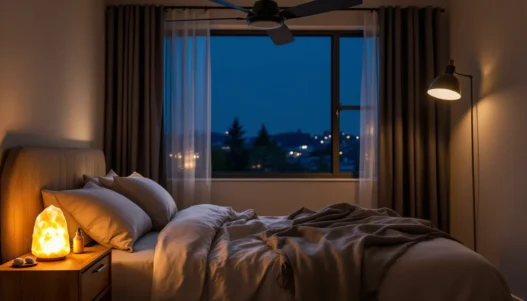
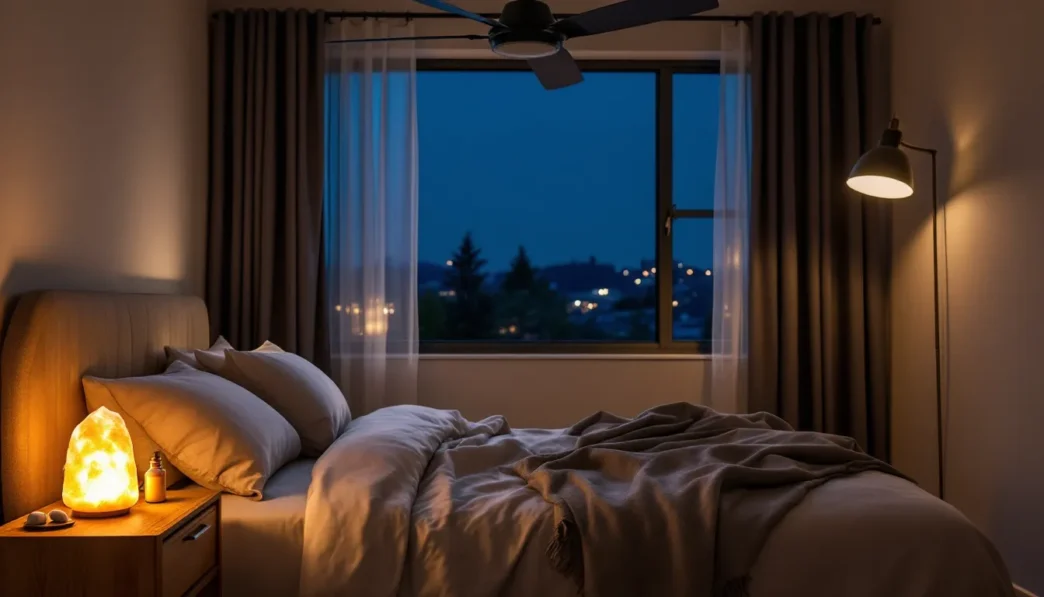
After sunset, try shifting to warm-toned lighting, amber or candlelight works beautifully. I keep a small salt lamp on my nightstand and it casts just enough of a warm, subtle glow to move around without flipping on overhead lights. If you’re a reader before bed, a soft book light with a warm filter is far gentler than a tablet screen.
Blackout curtains or a well-fitted sleep mask can transform a room. The goal isn’t just dimness, it’s creating an environment where the quality of darkness feels heavy, smooth, and enveloping, which naturally supports Kapha’s settling energy at night.
One thing I’d gently suggest avoiding: falling asleep with the TV on. The flickering, mobile light combined with unpredictable sound is one of the fastest ways to push Vata out of balance during sleep.
Do this today: Dim your lights or switch to warm-toned lighting at least 60–90 minutes before bed. Takes about 2 minutes to set up. Particularly helpful for Pitta and Vata types, though everyone benefits. Not ideal if you have seasonal depression that requires light therapy in the evening, in that case, work with your practitioner to find balance.
Managing Noise for Uninterrupted Rest
White Noise, Pink Noise, and Silence: What Works Best
Sound carries specific qualities in Ayurveda. A sudden, sharp noise, a car alarm, a notification ping, is mobile, sharp, and light. These are Vata-aggravating qualities, and they’re especially disruptive during the Vata time of night (2–6 a.m.), when sleep is already at its lightest and the nervous system is most sensitive.
Steady, low-frequency sounds, like the hum of a fan or gentle rain, carry stable, heavy, and smooth qualities. They act as a kind of acoustic blanket, grounding Vata’s tendency toward alertness and reactivity.
This is why many people find white noise or pink noise helpful. Pink noise, which emphasizes lower frequencies, tends to feel warmer and less harsh than white noise, making it a better fit for Vata-sensitive sleepers who find high-pitched hissing sounds a bit grating.
That said, silence works beautifully if your environment is naturally quiet. The key is consistency. Erratic shifts between quiet and loud are what destabilize sleep the most, because that mobile, unpredictable quality is Vata’s signature.
Soundproofing Strategies for Light Sleepers
If you live in a noisy area (I spent a year near a busy intersection, so I feel this one deeply), some simple adjustments can help. Heavy curtains absorb sound as well as light, a double benefit. Thick rugs on hard floors reduce echo and add a heavy, grounding quality to the room. Even placing a bookshelf against a shared wall can buffer noise.
Earplugs are a practical option, though I’d suggest soft, smooth ones, rough or tight-fitting plugs can irritate the ear canal, especially for Vata types whose skin tends toward dryness.
The Ayurvedic perspective here is refreshingly simple: your sleeping space is a sensory environment, and every sensory input either calms or agitates your doshas. Reducing sharp, unpredictable noise is one of the most direct ways to protect your prana, your life force, during its nightly restoration.
Do this today: If noise is an issue, try running a fan or a pink noise app at a low, steady volume tonight. Give it 3–5 nights before judging. Takes about a minute to set up. Especially supportive for Vata types and light sleepers. If you find any constant sound agitating rather than soothing, trust that, silence with earplugs may be your better path.
Finding Your Ideal Sleep Temperature
The Science Behind Thermoregulation and Sleep Quality
Ayurveda places enormous emphasis on the quality of temperature, and for good reason. Hot and cool are among the most powerful gunas influencing sleep.
Pitta dosha, which carries hot, sharp, and slightly oily qualities, peaks during the middle of the night. If your bedroom is already warm, you’re essentially adding heat to heat. The body can’t settle into its deepest rest because Pitta keeps the metabolic fire running a bit too high. This shows up as night sweats, restless tossing, vivid or agitated dreams, and waking up feeling like you ran a marathon in your sleep.
Vata types, on the other hand, tend to run cold and dry. An overly cold, drafty room can aggravate Vata’s already mobile, light qualities, leading to restlessness and anxiety during the night.
Kapha types generally tolerate cooler temperatures well, in fact, a slightly cool room helps counter Kapha’s natural heaviness and prevents that groggy, hard-to-wake-up feeling.
The sweet spot for most people? A room that feels cool but not cold, somewhere that allows your body’s core temperature to drop naturally, which is what healthy sleep physiology requires.
Bedding and Airflow Tips for Year-Round Comfort
This is where Ayurveda’s quality-matching approach gets really practical. Your bedding is the layer closest to your skin all night, so its qualities matter.
Light, breathable fabrics like cotton or linen carry light, cool, and smooth qualities, wonderful for Pitta types or warm-season sleeping. Heavier, softer materials like flannel or wool bring heavy, warm, and stable qualities that comfort Vata types during colder months.
Airflow matters too. A gently circulating breeze (ceiling fan on low, or a cracked window) keeps the air fresh and prevents that stale, damp, heavy quality that aggravates Kapha and allows ama to linger. But be mindful of drafts directly hitting your body, that moving, cold air is a Vata trigger, especially around the head and neck.
I like to keep one extra blanket folded at the foot of the bed. The temperature often shifts in the early morning hours (Vata time), and having something warm within reach means I don’t fully wake up to adjust.
Do this today: Tonight, try setting your bedroom a degree or two cooler than usual and notice how you sleep. If you wake up cold, add a layer. If you wake up warm, remove one. Takes no time at all, just attention. Good for all types. If you have a circulatory condition that makes you very cold-sensitive, prioritize warmth and consult your practitioner.
The Bedroom Reset: Decluttering and Redesigning Your Sleep Space
Removing Sleep Disruptors From the Bedroom
In Ayurveda, the space around you carries subtle energy, and clutter is not neutral. A bedroom filled with laundry piles, work papers, exercise equipment, and blinking electronics holds mobile, rough, and sharp qualities. Even if you’re not consciously aware of it, your nervous system registers all of it.
This is one of the quieter ways ama builds up, not just from food, but from unprocessed sensory input. Your mind, working to catalog and manage all those visual signals, never fully rests. The result? Ojas, your deepest reserve of vitality and immune resilience, gets slowly depleted.
The correction is straightforward. Remove anything from the bedroom that isn’t related to sleep or intimacy. Work stays in another room. Phones charge in the hallway (or at least across the room, face-down). Even clearing one nightstand of unnecessary objects can shift the room’s quality from chaotic to calm.
I once worked with someone who simply moved her desk out of the bedroom, and she told me she slept better that very first night. The room’s energy shifted from active and sharp to stable and smooth, and her Vata-dominant nervous system responded immediately.
Building a Relaxing Pre-Sleep Routine Around Your Environment
Ayurveda’s evening routine, part of dinacharya (ideal daily rhythm), isn’t about adding a dozen steps. It’s about creating a transition that signals to your body and mind: “We’re shifting gears now.”
A simple approach that I love: about 30–45 minutes before sleep, dim the lights (you’ve already got this piece), then gently massage the soles of your feet with warm sesame oil or coconut oil. This is called padabhyanga, and it’s one of Ayurveda’s most effective practices for calming Vata. The warm, oily, heavy qualities of the oil directly counter the dry, light, mobile qualities that keep the mind spinning.
Follow that with a few minutes of slow, deep breathing, nothing complicated. Just long exhales. This settles prana and tells the nervous system it’s safe to let go.
The environment supports this transition. A room that’s dim, cool, quiet, and uncluttered becomes a container for rest, like a nest that your body recognizes and trusts.
Do this today: Choose one thing to remove from your bedroom tonight, one item that doesn’t belong to sleep. Then try the foot oil massage for just 5 minutes before bed. Especially powerful for Vata and Pitta types. If you have very oily skin or a Kapha imbalance, use a lighter oil like sunflower, or simply do the breathing practice without oil.
Putting It All Together: A Step-by-Step Bedroom Audit
Now let’s bring everything together with a simple bedroom audit you can do tonight. Think of it as a reset, a conscious look at the qualities your room holds and how they align with the qualities of deep, nourishing rest.
Start with light. After sunset, walk into your bedroom and notice what’s glowing. Swap harsh overhead lights for warm, dim alternatives. Cover or remove any standby lights from electronics. Consider blackout curtains if outside light is an issue.
Move to sound. Stand quietly in your room for 60 seconds. What do you hear? Traffic? A ticking clock? A buzzing appliance? Address the biggest offender first, heavy curtains, a steady sound source, or earplugs.
Check temperature. Does the room feel slightly cool and fresh, or stuffy and warm? Adjust your thermostat, open a window, or swap your bedding for something more seasonally appropriate.
Scan the space. Look around. Does this room say “rest” or does it say “unfinished business”? Clear surfaces. Remove screens. Let the room breathe.
Finish with your routine. Establish one consistent pre-sleep practice, foot massage, slow breathing, or simply sitting quietly for 5 minutes in your newly reset space.
Now, let me share how to personalize all of this based on your constitution.
If you’re more Vata, your biggest enemies are cold drafts, erratic noise, and a cluttered, overstimulating room. Prioritize warmth, soft textures, and heaviness. Warm oil on your feet is non-negotiable. Keep a consistent bedtime (ideally before 10 p.m., during that Kapha window). Avoid falling asleep to podcasts or audiobooks, the mental stimulation keeps Vata spinning. Try this tonight: Warm foot massage with sesame oil, 5 minutes, in a dim room. Perfect for anyone who tends toward anxiety, dry skin, or racing thoughts at night. Not the best fit if you’re currently running very hot or dealing with active Pitta inflammation.
If you’re more Pitta, heat and light are your main disruptors. Keep the room cool, use breathable cotton bedding, and make darkness a priority. A few drops of coconut oil on the soles of your feet (cooling rather than warming) can be lovely. Avoid stimulating content, news, intense books, heated conversations, within an hour of bed. Pitta’s sharp, hot qualities need to be met with cool, smooth, and soft. Try this tonight: Switch to cotton sheets if you haven’t, and set the room one or two degrees cooler. Takes 2 minutes. Ideal for anyone who runs warm, sleeps restlessly, or wakes up irritable. If you tend toward coldness or have a Vata imbalance, keep the temperature moderate rather than truly cool.
If you’re more Kapha, stagnation and heaviness are your patterns. A slightly cool room with good airflow keeps things fresh. Lighter bedding prevents that “sinking into quicksand” oversleep. Try to avoid eating heavily in the evening, that late-night snack adds heaviness upon heaviness, dampening agni and building ama. A brisk walk after dinner, followed by a slightly earlier bedtime, supports Kapha beautifully. Try this tonight: Open a window slightly for fresh air circulation and choose lighter bedding. Takes a minute. Great for anyone who oversleeps yet wakes tired, or feels foggy in the morning. If it’s very cold outside or you run cold naturally, keep the window adjustment minimal and focus on the lighter bedding instead.
Seasonal Adjustment
Your healthy sleep environment isn’t static, it shifts with the seasons, and Ayurveda’s ritucharya (seasonal rhythm) guides this naturally.
In summer’s heat, Pitta is already elevated in the atmosphere. Lean into cooling: lighter covers, more airflow, perhaps sleeping on the cooler side of the house. Cotton and linen become your friends.
In winter, Vata’s cold, dry, mobile qualities dominate. This is when to layer on warmth, heavier blankets, closed windows (or just barely cracked), warm oil massage before bed, and maybe a cup of warm spiced milk in the evening.
During the wet, heavy days of late winter and spring, Kapha rises. Keep the room well-ventilated to avoid dampness and stagnation. Lighter, drier bedding helps, and airing out pillows and mattresses becomes especially worthwhile.
Do this today: Look at the season you’re in right now and make one adjustment to your bedding or airflow that matches it. Takes about 5 minutes. Relevant for all constitutions, just lean toward your dosha’s seasonal vulnerability.
A Quick Note on Modern Life
I find it remarkable how closely Ayurveda’s environmental sleep principles align with what modern sleep research now confirms, that darkness, cool temperatures, quiet consistency, and a decluttered space measurably improve sleep quality. The difference is that Ayurveda doesn’t stop at “what works”, it explains why it works through the logic of qualities and constitution. And it gives you a way to personalize the advice rather than following a one-size-fits-all checklist.
Your nervous system, your digestion, your vitality, they’re all listening to your bedroom environment every single night. When you align that environment with your body’s actual needs, sleep stops being something you chase and starts being something that comes to you.
Do this today: Pick the one insight from this article that resonated most and apply it tonight. Just one. Give it a week before adding another. Takes 5 minutes at most. This approach works for everyone, the key is consistency over complexity.
Conclusion
A healthy sleep environment isn’t built overnight, and it doesn’t require a complete home renovation. It’s built one quality at a time, dimming a light here, softening a texture there, cooling the air just a little, and clearing the visual noise that keeps your mind humming.
What I love about the Ayurvedic approach is that it trusts your body’s intelligence. When you create the right conditions, when the room is cool, dark, quiet, and calm, your body already knows how to sleep deeply. You’re not forcing anything. You’re just removing the obstacles.
Your ojas rebuilds. Your tejas clarifies. Your prana settles. And you wake up feeling like yourself again.
I’d love to hear from you, what’s the one thing about your bedroom that you suspect might be disrupting your sleep? Drop it in the comments, and let’s figure it out together. And if this resonated, consider sharing it with someone in your life who’s been struggling with restless nights. Sometimes the smallest shift makes the biggest difference.