


Understanding Anxiety and How Natural Approaches Can Help
In Ayurveda, anxiety is understood primarily as a Vata imbalance, an excess of the mobile, light, dry, subtle, and cold qualities that govern movement in the body and mind. Think of it this way: when the wind picks up in nature, leaves scatter, dust swirls, and nothing stays put. That’s what happens internally when Vata rises. Your thoughts race. Your breath gets shallow. Sleep becomes elusive.
But here’s where it gets interesting, anxiety doesn’t show up the same way for everyone.
If you’re naturally Vata-predominant, anxiety often feels like scattered worry, a buzzing nervousness, or a sense of being ungrounded. For Pitta types, anxiety tends to burn hotter, it can look like irritability, a sharp inner critic, or the feeling that everything needs to be controlled right now. Kapha types may experience anxiety as a heavy, stuck dread, a foggy paralysis where you can’t motivate yourself to act, even though worry sits like a weight on your chest.
The root cause, or nidana, often involves irregular routines, overstimulation, cold and dry foods, lack of nourishing touch, or simply living at a pace that outstrips your body’s capacity to digest experience. And that word, digest, is key. Because in Ayurveda, you don’t just digest food. You digest emotions, sensory input, and everything life throws at you.
Natural remedies for anxiety work because they address these root qualities. Instead of only managing symptoms, you’re restoring the warm, stable, grounding, and oily qualities that counterbalance Vata’s restless nature. You’re rebuilding what Ayurveda calls ojas, your deep reserve of vitality and calm resilience.
Do this today: Pause and notice which pattern sounds most like your anxiety, scattered, fiery, or heavy. Just naming it is the first step. Takes about two minutes of honest reflection. This is for anyone experiencing recurring worry, regardless of your background with Ayurveda.
Breathwork Techniques for Immediate Calm
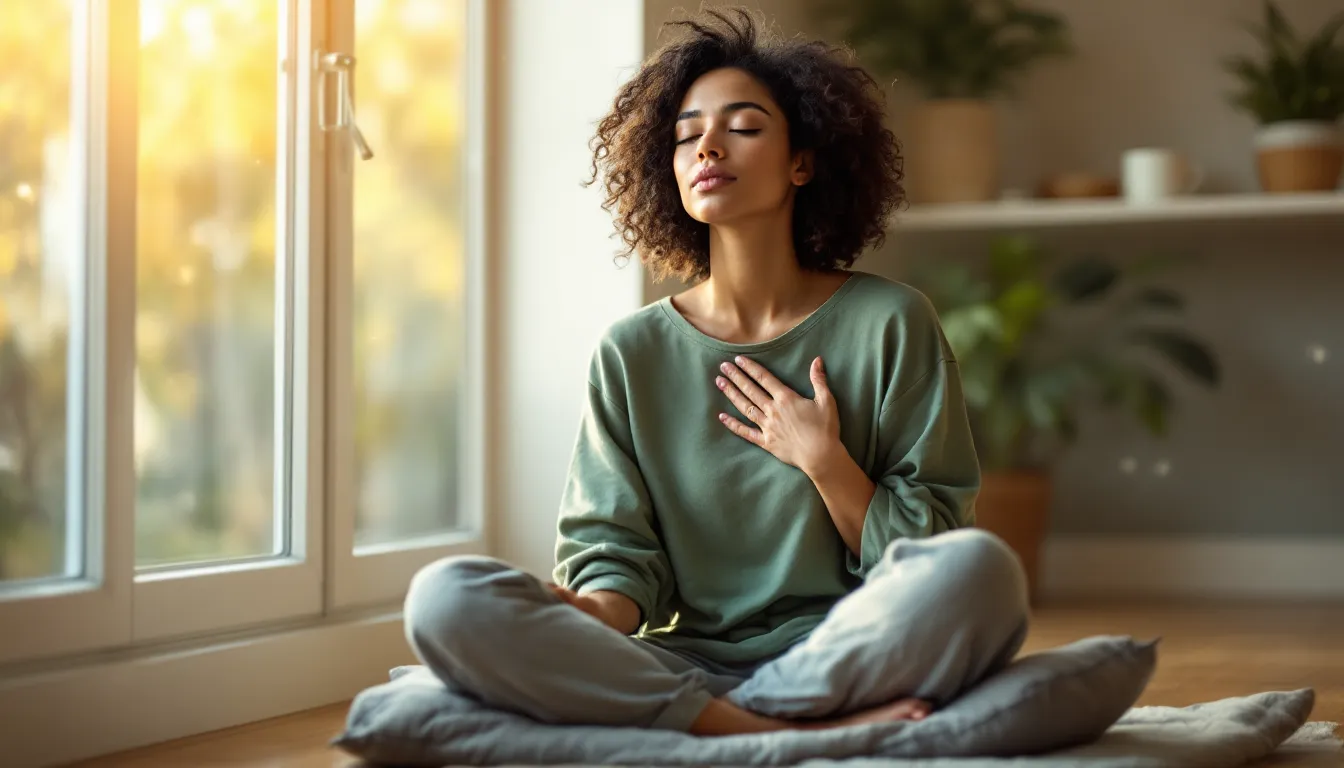
Your breath is the fastest lever you have. In Ayurveda, breath is directly linked to prana, the vital life force that governs your nervous system, your mental clarity, and your sense of being alive and present. When anxiety spikes, prana becomes erratic. It moves upward and outward, making you feel spacey, panicky, or disconnected.
Breathwork brings prana back down. It invites the stable, warm, and smooth qualities into a system that’s become mobile, rough, and cold. And unlike a supplement or a meal, it works in seconds.
Box Breathing and the 4-7-8 Method
Box breathing is about as simple as it gets. You inhale for four counts, hold for four, exhale for four, hold for four. That’s one cycle. The evenness of it, the equal rhythm, calms Vata’s irregularity. It’s like putting a steady hand on a shaking table.
The 4-7-8 method goes a step further. Inhale through your nose for four counts, hold gently for seven, and exhale slowly through your mouth for eight. That long exhale is where the magic lives. It activates your body’s rest-and-repair response and grounds the subtle, light quality of anxious energy into something heavier and more settled.
I find box breathing works best in acute moments, the meeting that’s making your palms sweat, the 3 a.m. wakeup with a racing mind. The 4-7-8 method is wonderful as a daily ritual, perhaps before meals or at bedtime, because it also supports your digestive fire (agni) by settling the nervous system before you ask your body to process food.
Do this today: Try three rounds of box breathing right now, wherever you are. It takes about ninety seconds. This works for all constitution types, though if you feel light-headed (more common in Vata types), shorten the holds and keep the breath gentle rather than forced.
Mindfulness and Meditation as Daily Anchors
If breathwork is the emergency brake, meditation is the long-term recalibration. In Ayurvedic terms, a consistent meditation practice strengthens tejas, your inner clarity and discernment. Tejas is the metabolic spark that helps you process experience cleanly, without leaving behind residue. When tejas is low, undigested impressions pile up, what Ayurveda calls ama of the mind, and that mental ama fuels anxiety loops.
You know the feeling. You replay a conversation for the fifth time. You catastrophize about next week. That sticky, repetitive quality? That’s mental ama. Meditation doesn’t suppress those thoughts. It gently metabolizes them by giving your awareness a stable, warm resting place.
Building a Sustainable Meditation Habit
Here’s where I see people trip up: they try to meditate for thirty minutes on day one, feel restless, and quit by Thursday. Ayurveda would call that a Vata approach to building a habit, enthusiastic, irregular, unsustainable.
Instead, try anchoring your practice to something you already do. After brushing your teeth in the morning, sit for five minutes. That’s it. Let your attention rest on the sensation of breathing, the cool air entering your nostrils, the warm air leaving. When your mind wanders (it will, constantly), come back without judgment.
This daily repetition builds the stable and heavy qualities that directly oppose Vata’s mobile, light nature. Over weeks, you’ll notice your baseline anxiety starts to lower, not because you’ve thought your way out of it, but because your nervous system has genuinely learned a new resting state.
For Pitta types, I’d suggest keeping meditation cool and spacious, no aggressive concentration or “achieving” a state. For Kapha types, a slightly more active practice like walking meditation prevents the dullness that can creep in during seated stillness.
Do this today: Set a five-minute timer and sit quietly after your morning routine. No apps needed, no special cushion. Takes five minutes. This is for everyone, but especially powerful for Vata and Pitta types who tend toward mental overactivity. If you’re in an acute mental health crisis, meditation alone isn’t a substitute for professional support.
Movement and Exercise for Anxiety Relief
There’s a reason a good walk can shift your entire mood. Movement redirects prana that’s gotten stuck or scattered. In Ayurvedic thinking, anxious energy is often Vata that’s accumulated in the colon and nervous system, the two main seats of Vata in the body. Gentle, rhythmic movement helps move that trapped wind downward and out, which is exactly the direction it needs to go.
But the type of movement matters more than most people realize.
High-intensity workouts, the kind that leave you breathless and depleted, can actually increase the dry, light, and mobile qualities that are already elevated in anxiety. You might feel temporarily better from the endorphin hit, but an hour later, you’re more wired than before. I’ve seen this pattern in myself and in so many others.
What works better for most anxious constitutions is movement that’s slow, rhythmic, grounding, and warm. Walking in nature. Gentle yoga with long holds. Swimming. Tai chi. These activities build the smooth, oily, heavy qualities that Vata craves.
Yoga, specifically, has an Ayurvedic advantage because it directly works with prana through posture and breath together. Forward folds are calming. Hip openers release stored tension. Legs-up-the-wall for ten minutes before bed can feel like a reset button for your entire nervous system.
That said, if you’re a Kapha type experiencing anxiety as heaviness and stagnation, you might genuinely benefit from more vigorous movement, a brisk hike, dancing, or a faster-paced yoga flow. The key is matching the exercise to what your body actually needs, not what’s trending.
Do this today: Take a twenty-minute walk, ideally outside, ideally without headphones. Let your arms swing. Breathe through your nose. This is for all types, but Vata-predominant folks will notice the most immediate shift. If you have mobility limitations, even gentle seated stretches with deep breathing will help move stagnant prana.
Herbal Remedies and Nutritional Support
Food is medicine, you’ve heard that before. But in Ayurveda, it’s not a metaphor. What you eat directly affects your agni (digestive fire), and when agni is disturbed by anxiety, it produces ama, that sticky, undigested residue that clouds thinking, heavies the body, and feeds the anxiety cycle.
Signs of ama include a coated tongue in the morning, sluggish digestion, brain fog, and a general sense of heaviness that doesn’t match how much you’ve eaten. When anxiety and ama coexist, you get a particularly frustrating combination: a wired mind in a tired body.
The Ayurvedic correction starts with protecting your agni. That means warm, cooked, slightly oily foods eaten at regular times. Cold smoothies, raw salads, and ice water, while popular in wellness culture, tend to dampen agni and increase the cold, rough, light qualities that aggravate Vata.
Try starting your day with something warm and grounding. Oatmeal cooked with ghee and a pinch of cinnamon. A bowl of stewed apples with cardamom. Warm milk with nutmeg before bed. These aren’t random comfort foods, they specifically carry the heavy, warm, smooth, and oily qualities that pacify Vata and rebuild ojas.
Adaptogens, Teas, and Supplements Worth Considering
Ayurveda has a deep herbal tradition for calming the mind. Ashwagandha is probably the most well-known, it’s warm, heavy, and oily in its qualities, making it a direct counterbalance to Vata’s cold, light dryness. It nourishes ojas over time and supports the body’s ability to handle stress without depletion.
Brahmi (Bacopa monnieri) works differently, it’s cooling and subtle, which makes it especially helpful when anxiety has a Pitta edge, that sharp, irritable quality. It supports tejas and mental clarity without overstimulating.
Tulsi (holy basil) tea is one of my personal favorites. It’s warming, slightly pungent, and has a gentle uplifting quality that moves stagnant prana without creating agitation. A cup in the late afternoon can bridge that anxious gap between the workday and evening.
A few cautions, though. Herbs are potent. Ashwagandha isn’t ideal for everyone, if you run very hot (strong Pitta), it can sometimes increase heat. Brahmi in excess can cool agni too much for Kapha types. Start slowly, pay attention, and ideally work with a practitioner who understands your constitution.
Do this today: Swap your afternoon coffee for a cup of tulsi tea. Takes two minutes to steep. This is for all types, especially Vata and Pitta. Not for anyone with known herb sensitivities or who is pregnant, consult a professional first.
Sleep Hygiene and Stress-Reducing Evening Routines
Anxiety and poor sleep feed each other in a vicious loop. In Ayurvedic terms, the evening hours, roughly 6 p.m. to 10 p.m., fall in the Kapha time of day. This is when nature offers you its heaviest, most grounding energy. Your body wants to wind down. But if you push past that Kapha window into the late-night Pitta time (10 p.m. to 2 a.m.), you hit a second wind. The mind sharpens, thoughts race, and now you’re lying in bed at midnight with your brain running inventory on every mistake you made in 2019.
This is one of the most practical Ayurvedic timing principles I can share: aim to be in bed by 10 p.m. Not because of some arbitrary rule, but because you’re riding the wave of Kapha’s natural heaviness instead of fighting against Pitta’s midnight fire.
Your evening routine, a form of dinacharya (daily rhythm), can make or break your sleep quality. Here’s what I’ve found works beautifully:
Eat your last meal at least two to three hours before bed, and keep it lighter than lunch. A heavy dinner forces agni to work overtime when it naturally wants to rest, producing ama that shows up as grogginess and disturbed dreams.
About an hour before sleep, try rubbing warm sesame oil on the soles of your feet. This is a classic Ayurvedic practice called pada abhyanga. The feet are rich in nerve endings, and warm oil is heavy, smooth, and oily, a direct antidote to Vata’s dry, rough, mobile qualities. It sounds almost too simple, but I’ve had nights where this single practice was the difference between tossing for hours and drifting off within minutes.
Dim your lights. Step away from screens. Let the environment mirror the qualities you’re cultivating: dark, warm, quiet, stable.
Do this today: Tonight, oil your feet with warm sesame oil before bed and aim to have lights out by 10 p.m. Takes five minutes. This is especially powerful for Vata and Pitta types. If you have a sesame allergy, coconut oil works well for Pitta, and almond oil is a gentle alternative for Vata.
Journaling, Social Connection, and Other Grounding Habits
Not everything that settles anxiety happens on a yoga mat or in a teacup. Some of the most potent natural remedies for anxiety are relational and expressive, and Ayurveda has a framework for why they work.
Journaling, for instance, takes the subtle, mobile quality of anxious thoughts and makes them gross (in the Ayurvedic sense, meaning tangible, concrete, visible). When a worry lives only in your head, it spins. When you write it down, it becomes something you can look at, and looking at it changes your relationship to it. This is a direct shift from the subtle to the gross, from the mobile to the stable.
I like to journal for about ten minutes in the evening, letting whatever’s circling in my mind spill onto the page without editing. It doesn’t need to be poetic. It just needs to move from inside to outside.
Social connection works on a different axis. Warm, safe human contact increases ojas, that deep vitality reserve I mentioned earlier. Ojas is built through nourishment, rest, love, and the feeling of belonging. Isolation depletes it. So calling a friend, sharing a meal with someone you trust, or even a long hug can be genuinely medicinal from an Ayurvedic perspective. It brings warm, smooth, heavy qualities into a system that’s gone cold and scattered.
Other grounding habits worth considering: spending time near water, cooking a meal from scratch (the warmth, the aromas, the rhythm of chopping), gardening with your hands in the soil, or simply sitting with a pet. These all share the same quality profile, they’re slow, warm, tangible, and stable.
Now let me get specific about how to tailor all of this to your unique constitution.
If you’re more Vata, your anxiety likely feels like scattered worry, racing thoughts, insomnia, and a sense of being unmoored. Your correction is all about warmth, regularity, and heaviness. Eat warm, cooked, well-spiced meals at the same times every day. Favor sesame oil, on your body, in your food. Keep your environment warm and clutter-free. Move gently. Avoid caffeine, raw foods, and staying up late. The one thing to especially avoid: irregular schedules. Vata thrives on rhythm.
Do this today (Vata): Have a warm bowl of soup for dinner tonight, and be in bed by 9:45 p.m. Takes no extra time, just intention. This is for anyone who recognizes the scattered, cold, restless pattern. Not ideal if your anxiety runs hot and irritable, that’s more Pitta.
If you’re more Pitta, your anxiety has a sharper edge, frustration, perfectionism, a burning need to control outcomes, sometimes acid reflux or skin flare-ups alongside mental tension. Your correction involves cooling, softening, and spaciousness. Favor sweet, bitter, and astringent tastes. Coconut oil is your friend, in cooking and on your skin. Spend time near water. Practice non-competitive movement. Let things be imperfect. The one thing to especially avoid: overworking through the Pitta hours (10 a.m.–2 p.m. and 10 p.m.–2 a.m.).
Do this today (Pitta): Take a ten-minute walk near water, a lake, a stream, even a fountain, and leave your phone behind. Takes ten minutes. This is for the driven, intense type whose anxiety feels like burning pressure. Not the best fit if your anxiety is more foggy and lethargic.
If you’re more Kapha, your anxiety may surprise you because it doesn’t look like the “typical” anxious person. It feels like heaviness, dread, withdrawal, resistance to change, and emotional eating. Your correction involves lightness, warmth, stimulation, and movement. Favor pungent, bitter, and astringent tastes. Dry-brush your skin in the morning to stimulate circulation. Move your body daily, and make it vigorous enough to break a light sweat. The one thing to especially avoid: sleeping during the day, which increases the dull, heavy qualities that feed Kapha-type anxiety.
Do this today (Kapha): Do fifteen minutes of brisk walking or dancing first thing in the morning, before breakfast. Takes fifteen minutes. This is for the heavy, stuck pattern. Not recommended if you’re feeling depleted and underweight, that’s a Vata picture, and you need nourishment instead.
When to Seek Professional Support Alongside Natural Practices
I want to be honest about something. Ayurveda is a profound system, and the natural remedies for anxiety I’ve described here can genuinely transform your daily experience. But they have limits, and recognizing those limits is part of wisdom, not failure.
If your anxiety is so intense that you can’t function, can’t eat, can’t sleep, can’t work, can’t maintain relationships, that’s your body telling you it needs more support than self-care alone can provide. If you’re having panic attacks, persistent intrusive thoughts, or thoughts of self-harm, please reach out to a mental health professional.
Ayurveda and modern mental health care aren’t enemies. In fact, they complement each other beautifully. A therapist can help you process trauma and reframe thought patterns. An Ayurvedic practitioner can help rebuild your ojas, strengthen your agni, and create a daily rhythm that supports your nervous system from the ground up. The combination is more powerful than either alone.
Seasonal shifts are also worth watching. Late autumn and early winter, Vata season, can intensify anxiety for almost everyone, but especially for Vata-predominant types. The cold, dry, windy qualities of the season mirror Vata’s own nature, creating a kind of amplification effect. If you notice your anxiety reliably worsens during these months, that’s a signal to double down on warming, oily, grounding practices: heavier foods, more oil on your skin, earlier bedtimes, and less travel if possible. This is Ayurveda’s ritucharya, seasonal rhythm, and it’s one of the most practical tools I know for staying ahead of anxiety before it peaks.
Do this today: Honestly assess whether your current anxiety level is manageable with self-care or whether you’d benefit from professional support. There’s no time estimate for this, just a moment of truthful reflection. This is for everyone, no exceptions.
Conclusion
Anxiety doesn’t have to be a life sentence, and calming it doesn’t require a complete overhaul of your existence. What Ayurveda teaches, and what I’ve experienced firsthand, is that small, consistent, quality-based shifts accumulate into something remarkable. A warm meal eaten in peace. A few minutes of breathing before bed. Oil on your feet. A walk without your phone.
These aren’t dramatic interventions. They’re the quiet, daily acts of befriending your own body. And over time, they rebuild the ojas, tejas, and prana that anxiety erodes, the deep vitality, the mental clarity, the steady life force that lets you move through your days with more ease.
Start where you are. Pick one practice from this article that resonated and try it for a week. Notice what shifts, not just in your mind, but in your digestion, your sleep, the quality of your mornings.
I’d love to hear from you. What does your anxiety feel like in your body, and which of these practices are you drawn to try first?


